If Borobudur asks you to walk inward, Prambanan asks you to look up. Where the Buddhist temple is a hill you climb in a spiral, Prambanan is a sudden vertical forest of stone, the tallest spire, the shrine of Shiva, stands roughly forty-seven metres into the Javanese sky, and around it the towers crowd so close they seem to lean toward one another like people in prayer. It is the largest Hindu temple compound in Indonesia, raised in the ninth century, and the first time you stand in the inner courtyard with all those spires above you, the scale does something to your chest that a photograph simply cannot carry. The numbers, two hundred and forty temples in the original plan, are not the point. The point is that the builders wanted you to feel small in a particular, deliberate way.
Rama earns a commission when readers book through the Viator links on this site, at no extra cost to the traveller. This does not affect which tours are recommended, every tour passes three checks: guide quality, safety record, and value. Rama does not run a tour company. He does not sell packages.
My name is Rama Kusuma. I live in Sleman, on the southern slope of Merapi, and Prambanan sits just east of me, close enough that I have watched its silhouette in every kind of light there is. My father guided Borobudur for thirty years and taught me to read a temple as an argument about how to live rather than a column of statistics. But Prambanan I came to on my own, and I love it the way you love the thing you discovered for yourself. The reliefs that run along the inner balustrades of the Shiva and Brahma temples tell the Ramayana, Rama and Sita, the abduction, the war, the white monkey Hanuman leaping the ocean, and to walk them clockwise, panel after panel, is to read the oldest story this island knows, told by people who believed it down to their bones. If that story matters to you, the Borobudur, Prambanan and Ramayana Ballet full-day tour (4.91★) reads the Hindu epic carved into the walls in the afternoon, then watches it danced under the lit spires after dark.
This site is not a tour company. I do not run vans or sell packages, what I do is read the listings the way a guide reads them and tell you which ones fit what you actually came to feel. Prambanan is easier to book than Borobudur in one respect: there is no quota lottery for the upper terraces here. But it carries its own confusions, and the biggest of them, the Ramayana Ballet, the open-air theatre, the wet-season shuffle indoors, catches travellers every season. So before we get to the four tours, let me tell you what Prambanan actually is on the ground, and then I will match each tour to the kind of traveller it really suits, starting with the temples-by-day, Ramayana Ballet by night tour, the one I would pick for a couple who will only be here once.
What Prambanan actually is when you get there
Most people picture the three great temples of the central courtyard, Shiva in the middle, Brahma to the south, Vishnu to the north, and stop there. But the compound is bigger and stranger than that postcard. Inside the same archaeological park, a short walk north, stands Sewu, a vast Buddhist complex older than the Hindu temples beside it, a Buddhist and a Hindu monument raised almost as neighbours, which tells you something true about ninth-century Java that the guidebooks rush past. Almost no day-tripper walks up to Sewu. They photograph the three spires, buy a cold drink, and leave. If you have the legs, the walk north is the quietest, most rewarding twenty minutes in the whole park.
A foreigner ticket runs around IDR 375,000, roughly twenty-three US dollars. If you are also doing Borobudur, and most visitors are, there is a combined Borobudur-and-Prambanan ticket that works out cheaper than buying the two separately, valid across both within forty-eight hours. The counters rarely volunteer it; you must ask for it by name. And one honesty I owe you before you arrive: the great 2006 earthquake shook this valley hard, and Prambanan still carries the work of it. Some shrines are fenced, some are scaffolded, restoration goes on year after year. It does not diminish the place, it deepens it. You are looking at a temple still being put back together by hand, stone by numbered stone, the way it has been since the rubble was first sorted.
Four Prambanan tours, and who each one is really for
Prambanan is almost never sold alone, it is the eastern bookend to a Borobudur day, the temple you reach in the afternoon light. The difference between the tours below is not quality; all four are excellent and well-reviewed. The difference is the shape of your day: whether Prambanan is your last unhurried stop or a rushed final tick, whether you set your own pace, and whether you stay on into the evening for the Ramayana Ballet. Here is how I match travellers to each.

The classic full sweep, with Prambanan saved for last light
If you have one big day and want to see everything Central Java is famous for, this is where most first-timers rightly begin, the Borobudur Sunrise, Merapi Volcano & Prambanan full-day tour. It is the most-reviewed temple tour I know of, 4.91 stars across more than a thousand travellers, and it earns that standing. It does the thing I quietly approve of: it saves Prambanan for the end of the day, when the afternoon sun warms the andesite to honey and the crowds have thinned. After a pre-dawn sunrise and the lava country near my own home, you arrive at the Hindu temples for the finest light of the whole circuit.
Here is his is a twelve-hour day that starts before dawn, and sunrise tours quote the pickup time, not the start time, so a 3:30 pickup means an hour-plus in the dark before anything happens. By the time you reach Prambanan you will be tired, and a tired traveller misses the Ramayana reliefs entirely, walking the courtyard for photos and leaving. If you have the legs, it is a glorious arc of a day. If you tire easily, or travel with small children or elderly parents, Prambanan deserves better than your exhausted final hour.
See dates & prices →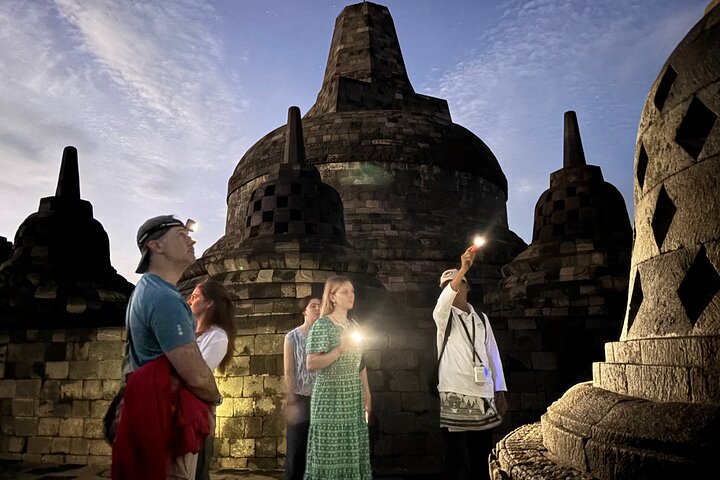
For couples and families who refuse to be rushed: private and flexible
Some travellers do not want to keep a group's pace, and at Prambanan I understand it completely, this is a temple to linger in, not march through. The Borobudur Climb Up and Prambanan all-inclusive private tour sits at 4.96 stars, and being private is the whole offer, your own schedule, your own driver, as long as you like at each site. This is the day that lets you actually read the Ramayana balustrades panel by panel, or make the quiet walk north to the Sewu complex that group tours never have time for. Families who need a snack, a slower morning, and a bathroom on their own clock will breathe easier here too.
The trade-off is plain: private pricing is far higher per head than a shared seat. A solo budget traveller pays for empty places in the car. But split between two or four people who value setting their own pace, it stops being extravagant and becomes the sensible choice, especially at a temple that rewards the unhurried so richly.
See dates & prices →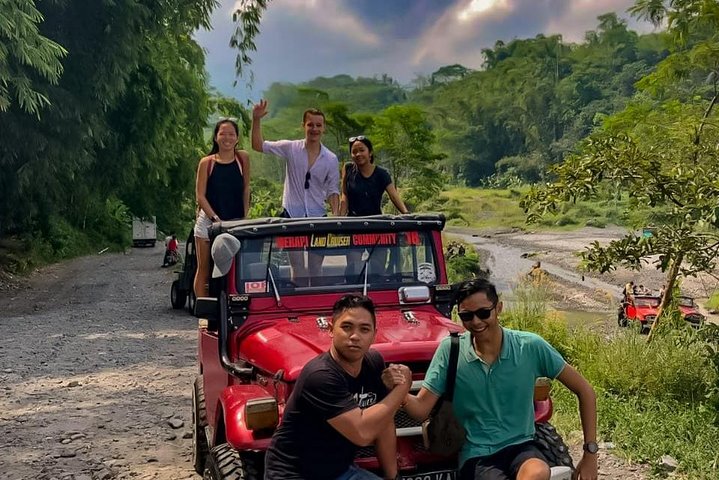
For those who want the story told twice, in stone, then in dance
This is the one I get most excited to recommend, because it closes a circle. The Borobudur, Prambanan & Ramayana Ballet day tour carries 4.91 stars across its reviews, and what makes it special is the evening: after you have walked the Ramayana carved into the temple's balustrades, you stay on to watch that same story danced. From roughly May to October, in the dry season, the ballet plays on the open-air stage with the floodlit spires of Prambanan rising directly behind the dancers, Sita, Rama, the demon king Ravana, Hanuman, moving against the silhouette of the temple where the tale is written in stone. In the wet months the performance moves to the covered indoor theatre nearby.
I will tell you a small story, because it changed how I describe this. In 2022 I had a couple booked for the open-air show and a storm rolled in off the plain at dusk; the performance was moved indoors at the last moment and I braced for their disappointment. Instead they came out glowing, the indoor hall is intimate, the rain drumming on the roof, the dancers close enough to read their faces. They told me they would not have traded the storm for clear sky. So if the weather turns, do not grieve the open-air stage. The story is the same story, and it finds you either way. Skip this tour only if a late evening undoes you, or if you genuinely have no patience for traditional dance, it is a real time and energy commitment on top of a full temple day.
See dates & prices →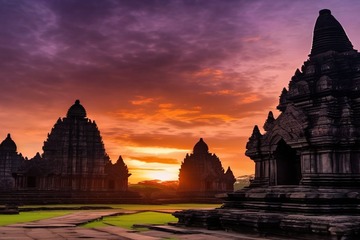
If the Borobudur climb is your non-negotiable, with Prambanan after
Most travellers pairing the two temples have one quiet anxiety, and it lives at Borobudur, not here: the capped, timed ticket to climb to the upper terraces, which sells out daily. The Borobudur ClimbUP guaranteed & Prambanan day tour sits at 4.96 stars and does the one thing that removes that worry: it guarantees your Borobudur summit slot in writing, then carries you east to Prambanan to finish. For the traveller whose single dream is to stand among the stupas at Borobudur's summit and see the Hindu temples the same day, this takes the quota gamble off the table entirely.
Who should look elsewhere? If your heart is set on Prambanan and the Ramayana, and Borobudur is the secondary stop, you are paying a premium for a guarantee that protects the other temple. Be honest about which monument is the reason you came. If it is the forest of Hindu spires, the private day or the ballet day will serve you better than a tour built around Borobudur's access problem.
See dates & prices →How I choose which Prambanan tours to recommend
I apply the same three checks to every tour on this site, in the same order. Here is exactly what each one means at Prambanan:
1. Guide quality. Prambanan is a story carved in stone, and a guide who only points and names the three big temples is selling, not teaching. The reliefs of the Ramayana run along the inner balustrades and they reward a guide who walks you through them in order, the abduction of Sita, Hanuman's leap, the burning of Lanka, so the temple becomes a narrative and not a row of towers. I learned the cost of getting the stone wrong the hard way at Borobudur: for nearly ten years I explained one relief as a shipwreck, until an archaeologist on my tour gently corrected me, and I stopped the group and admitted I had been wrong for a decade. My father taught me a guide who cannot say "I was wrong" is selling, not teaching. So I trust operators whose guides know these carvings deeply enough to be corrected by them.
2. Safety record. Prambanan is gentler underfoot than a volcano, but the 2006 earthquake left shrines fenced and scaffolded, the ground is uneven, and the full-sweep tours involve long hours and pre-dawn drives on dark roads. The ballet-day tours run late into the evening. I look for operators with proper drivers, sane schedules, and respect for the barriers around restoration work rather than ones who hurry you over rubble for a photograph.
3. Value. Not cheapest, value. At Prambanan this is mostly about whether the price is honest about what it includes: the temple entry, and for the ballet tours, the performance ticket and the open-air-versus-indoor question. The combined Borobudur-and-Prambanan ticket is cheaper than buying both separately, and a tour that quietly uses it is treating your money with respect. I earn a commission when you book through these Viator links, at no extra cost to you, that is how the site stays free. It does not change which tours pass the three checks, and plenty of well-paying listings never make it onto this page.
Rama's Prambanan rules
- Buy the combined Borobudur + Prambanan ticket if you're doing both. It's valid across both temples within 48 hours and it's cheaper than two separate entries, but counters and operators rarely volunteer it. Ask for it by name.
- Walk north to Sewu. The Buddhist complex inside the same park is older than the Hindu temples beside it and almost empty of visitors. Twenty quiet minutes on foot buys you the most peaceful corner of Prambanan, and a glimpse of how Buddhist and Hindu Java stood side by side in the ninth century.
- For the Ramayana Ballet, know your season before you book. Open-air stage with the floodlit spires behind the dancers runs roughly May to October; in the wet months it moves to the covered indoor theatre. The indoor show is intimate and wonderful in its own right, if rain moves you inside, you have lost nothing.
- Read the Ramayana along the inner balustrades, clockwise. The carvings on the Shiva and Brahma temples are the whole reason this place is more than a skyline. Walk them in order with a guide who knows the story, or you'll photograph the towers and miss the temple.
- Come for the late afternoon if you can choose. The low sun turns the dark andesite to honey, the day-trip crowds thin, and the spires throw long shadows across the courtyard. Midday is hot, bright, and crowded, the temple glows as the light softens.
- For any trip beyond the city ring road, hire a car and driver rather than relying on Gojek or Grab. The ride-hailing apps get patchy and expensive out at the temples, and you'll wait a long time for a car back. A hired car-and-driver for the day usually works out cheaper and far less stressful.
The mistakes I watch travellers make at Prambanan
The first is arriving exhausted. Because Prambanan is almost always the afternoon bookend to a pre-dawn Borobudur start, travellers reach the Hindu temples with nothing left in the tank. They walk the central courtyard for the obligatory photograph and leave, never once looking at the Ramayana reliefs that are the actual soul of the place. If the temple matters to you, protect your energy for it, choose a day that does not bury Prambanan under sixteen hours of touring, or pick the private tour that lets you slow down when you arrive.
The second is treating the Ramayana Ballet as an afterthought you can sort out on the night. The performance runs on a schedule, the open-air and indoor venues swap with the season, and good seats go. Decide before you travel whether the evening of dance is part of your trip, and book the tour that includes it rather than hoping to bolt it on after a full day. The couple I told you about, the ones the storm chased indoors, came out loving the night precisely because they had committed to it, they were not scrambling for tickets at dusk.
The third is skipping Sewu and the rest of the compound. Travellers see the three famous spires and assume that is Prambanan. It is not. The Buddhist complex to the north, the scattered minor shrines, the work of the 2006 restoration still going on around you, all of it is the temple, and all of it is quieter and stranger and more human than the postcard. Give yourself the walk.
And the fourth, quietly, is mistaking Prambanan for a rival to Borobudur, as if you must rank them. People ask me constantly which is the finer temple. As I explain on my about page, there isn't one, Prambanan reaches up like a prayer, Borobudur asks you to walk inward. There is only the right match between a traveller and a day. So do not arrive at Prambanan measuring it against the temple you saw this morning. Arrive ready to look up. Tell me what you came to feel, and the four tours above will sort themselves out.
Explore More
Related comparisons and guides:
Borobudur Sunrise from setumbu Hill , Merapi Volcano & Prambanan Full Day Tour
★★★★★ 4.9 (1,097 reviews) · From $99
Check Availability →Borobudur Climb To The Top, Prambanan Temple And Ramayana Ballet
★★★★★ 4.9 (120 reviews) · From $122
Check Availability →Borobudur Full Climb Up And Prambanan ALL INCLUSIVE PRIVATE Tour
★★★★★ 5.0 (181 reviews) · From $45
Check Availability →Borobudur ClimbUP guaranteed (sunrise option)& Prambanan Day Tour
★★★★★ 5.0 (164 reviews) · From $325000
Check Availability →