Rama earns a commission when readers book through the Viator links on this site, at no extra cost to the traveller. This does not affect which tours are recommended, every tour passes three checks: guide quality, safety record, and value. Rama does not run a tour company. He does not sell packages.
This is the question I am asked more than any other. A traveller has two or three days in Yogyakarta, a long list, and the same worry every time: if I can only properly do one of the two great temples, which one? They want me to name the better one. And I won't, not because I am dodging the question, but because after twenty years on these stones I know the question has no honest answer in that shape. Borobudur and Prambanan are not two versions of the same thing, where one is simply finer. They are two completely different arguments about how to reach the sacred. One asks you to walk inward and downward into yourself; the other lifts your eye up a stone spire toward the gods. Asking which is better is like asking whether a sunrise is better than a thunderstorm. If you have one big day and want the classic sweep of both, the most-reviewed Borobudur sunrise, Merapi and Prambanan full-day tour covers both temples. But read on, because the twelve-hour march is not the right day for everyone.
My name is Rama Kusuma. I live in Sleman, on the southern slope of Merapi, roughly between the two temples, Borobudur about forty kilometres northwest of my house, Prambanan a short drive east. My father guided Borobudur for thirty years before me, and the lesson he left me sits under this whole page: a temple is an argument about how to live, not a column of numbers. So I will not hand you a column of numbers and call one of them the winner. I will tell you what each temple is trying to make you feel, and then you will know which one is yours. Often the honest answer turns out to be: do both. I'll get to how, and to the combined ticket the operators almost never volunteer. If you have the time, the Borobudur, Prambanan and Ramayana Ballet full-day tour gives you both temples on one ticket.
Let me tell you about a retired German couple I guided one misty morning. At the top of Setumbu Hill, with the Kedu plain opening below us, the husband asked me to settle it once and for all and name the finest temple in Java. I started toward Borobudur out of habit, and then I stopped, and I told him the truth: Prambanan reaches up like a prayer, Borobudur asks you to walk inward. There is no winner between those two things. He went quiet, and then he said he trusted me more for refusing to sell him one. That is this whole page in a sentence.
The same century, two different prayers
Before I split them apart, here is what they share, because it surprises people how close these two temples are in time and place, and how far apart in spirit.
Both rose in the ninth century, within a few generations of each other, on the same fertile volcanic plain. Both were swallowed, by ash, jungle, and earthquake, and lay half-forgotten for centuries before being painstakingly brought back. Both were inscribed together as UNESCO World Heritage in 1991. And they sit only about an hour's drive apart, which is the single fact that makes the whole "which one" question softer than it first appears: you are rarely choosing between two cities, only between two mornings. But everything the two temples were built to do is opposite. Borobudur is Buddhist; it has no soaring towers at all, it is a solid stone mountain you ascend in slow, square spirals, reading carved life as you climb until the carvings fall away into open sky and seventy-two bell-shaped stupas. Prambanan is Hindu; it is all verticality, a cluster of sharp spires shooting upward, the tallest the Shiva temple at forty-seven metres, built to draw your soul up toward the divine. One is a walk into stillness. The other is a reach into height.
Side by side, the way I'd explain it in the car
When clients ask me to compare them on the drive in, this is roughly how it comes out, not as a sales sheet, but as the handful of differences that actually change your morning.
| Borobudur | Prambanan | |
|---|---|---|
| Faith | Buddhist | Hindu (with a Buddhist neighbour, Sewu) |
| The feeling | Inward and upward, a meditation you walk | Upward and outward, spires that pull the eye to the sky |
| Shape | One solid stone mountain, nine stacked platforms | A forest of sharp towers, 240 original temples once stood here |
| The carvings | Read them as you climb, life, desire, enlightenment in sequence | The Ramayana, carved on the walls and danced live in the evening |
| The headline number | Two million andesite stones, no mortar | The 47-metre Shiva temple, the tallest spire |
| Ideal light | Sunrise, dry season, the famous misty dawn | Morning any season; no shelter, so beat the afternoon storms |
| The catch at booking | Climb-to-top quota since 2023, book ahead or be turned away | No quota; just buy entry and walk in |
| The bonus stop nearby | Mendut, the oldest temple here, a magnificent seated Buddha | Sewu, a vast, quiet Buddhist complex behind the main temple |
When to choose Borobudur
Choose Borobudur if you came for stillness
Borobudur is for the traveller who wants to slow down, not tick a box. You don't really look at Borobudur the way you look at a cathedral from across a square, you enter it and you climb it, terrace by terrace, starting among carved scenes of ordinary human craving at the hidden base and rising through ten levels of stone storytelling until the carvings stop and you are standing among bare stupas with nothing above you but sky. The builders wanted your body to make the climb, not just your eyes. If the idea of a wordless, walking meditation at dawn moves something in you, if you would happily sit on a terrace and watch the light fill the valley without taking a single photograph, this is your temple.
Choose it, too, if the famous misty sunrise is the image in your head, that is a Borobudur experience, clearest in the dry season (roughly May to September) when the mornings are clear. But know the one trap before you go: since 2023 you cannot simply wander up to the top. Climbing the upper terraces needs a separate timed ticket with a small daily quota, a local guide, and special woven upanat sandals to protect the ancient stone. The cap fills early. I have stood at the gate and watched couples who flew across the world hear the word "sold out" and be left with only a courtyard view of a temple they could not climb. If the summit is your dream, book it days ahead, never at the counter. I walk through all four day-tour options, and which guarantees that climb slot, on my full Borobudur page. If climbing to the summit is the single thing you came for, the guaranteed ClimbUP tour locks your slot in writing, 4.96 stars and the quota gamble removed entirely.
When to choose Prambanan
Choose Prambanan if you came for drama and height
Prambanan is for the traveller who wants to be awed, to stand at the foot of a forty-seven-metre stone spire and feel small in the good way. Where Borobudur is a quiet horizontal walk, Prambanan is vertical theatre: a tight cluster of sharp, soaring towers, the central one dedicated to Shiva, surrounded by the ruins and reconstructions of what was once a complex of 240 temples. The walls of the main temples carry the Ramayana, the great Hindu epic of Rama and Sita, panel after panel, and in the dry-season evenings that same story is performed as a live ballet on the open-air stage with the lit spires behind the dancers. If you would rather a temple thrill you than still you, Prambanan is yours.
It also rewards the curious walker more than people expect. Most visitors crowd the central Shiva temple and miss that just a few hundred metres north stands Sewu, a huge and genuinely serene Buddhist complex, yes, a Buddhist temple right beside the Hindu one, which tells you something lovely about ninth-century Java. My standing advice: walk Prambanan from the back. Head to Sewu first thing while the buses mob the main temple, then return an hour later and have the headline almost to yourself. On the practical side, Prambanan has no climb quota, you just buy entry and go, which makes it the easier of the two to slot in at short notice. The one thing to respect is the weather: there is little shelter among the temples, so in the wet season go in the morning, before the afternoon storms roll across the plain and send everyone running. My full Prambanan page goes deeper into the tours and the ballet timings.
When to do both
Here is the answer I give most often, and the one operators are strangely quiet about: you may not have to choose at all. The two temples are only about an hour's drive apart, and there is a combined ticket covering entry to both, valid for 48 hours, and cheaper than buying the two separately. It is not always offered at the counter, and it is rarely volunteered by tour sellers, so you often have to ask for it by name. If your trip can spare two unhurried half-days, the combined ticket is the quiet bargain of Yogyakarta.
How I'd actually structure "both"
Borobudur at sunrise on one morning, slow, meditative, the climb slot booked well ahead, then Prambanan the following morning, walked from Sewu at the back forward to the Shiva temple, with the evening Ramayana ballet to close if it's the dry season. That sequence gives each temple its own light and its own headspace, instead of cramming both into one exhausted twelve-hour march. If you genuinely have only one day, plenty of excellent shared tours pair the two anyway, and most fold in the bonus stops, Mendut near Borobudur, Sewu behind Prambanan, that the rushed itineraries drive straight past. The private all-inclusive Borobudur and Prambanan tour gives you both temples self-paced, with time to actually walk the reliefs instead of racing the clock, 4.96 stars and worth the extra if setting your own pace matters.
If the one-big-day sweep is what suits you, the most-reviewed option most first-timers rightly begin with is the full-day Borobudur sunrise, Merapi and Prambanan tour, but read my Borobudur and Prambanan pages first, because a twelve-hour day starting before dawn is glorious for some travellers and miserable for others, and only you know which one you are.
The honest bit, before you decide
There is no correct answer here, and anyone who hands you one is selling something. Both temples are extraordinary; neither is the "best". A few honest pointers to settle it for yourself:
- If you only have one morning and you want calm: Borobudur, but book the climb ticket days ahead, or you'll get the courtyard, not the summit.
- If you only have one morning and you want spectacle: Prambanan, no quota, easy to arrange last-minute, and the evening ballet if the season allows.
- If you have two half-days: do both on the 48-hour combined ticket, ask for it by name; it's cheaper and rarely offered.
- Wet season, short on time: lean Prambanan in the morning (storms come in the afternoon, and there's no shelter); save Borobudur sunrise for a clear dry-season trip.
- Always carry small cash and patience. Walk both temples from the back, away from the buses, and give the stone the time it waited a thousand years for.
Setumbu Hill, a German couple, and the question I refuse to settle
Setumbu Hill is the small ridge across the Kedu plain from Borobudur, the spot every sunrise tour climbs to for the famous misty silhouette. I was up there in October 2024 with a retired German couple, Klaus and Margit, two days into their Yogyakarta trip. They had been to Prambanan the previous afternoon and raved about the spires, and now, waiting for the sun, Klaus turned to me and asked the question I have been asked maybe four hundred times since I started guiding. Pick one, he said. If you had to send me to one and only one temple, which would it be. I had my answer rehearsed, the training-wheels answer guides give, but I looked out at the fog pooling between the volcanoes and the silhouette of Borobudur coming up through it, and I told him the truth. I cannot honestly do it. Borobudur is a walk into stillness. Prambanan is a reach into height. They are not two versions of the same thing, they are two different arguments about what a temple is for. Klaus went quiet for a long time. Then he said, that is the first time a guide has refused to sell me a winner, and I trust you more for it. They ended up doing both, on the 48-hour combined ticket I get to in the next paragraph, and writing me an email from the airport that I still keep.
Two practical things that morning I want to leave you with. First, the dry season really matters. We were in October, one of the best months for that misty Borobudur sunrise, and the sky cooperated. The same morning in January or February is a coin flip. Second, the climb to the top of Borobudur is a separate ticket with a small daily cap, and I have watched people arrive at the gate at 7am without a reservation and be turned away. If the summit is the whole point, the day I would send you on is the guaranteed ClimbUP tour with Prambanan, because the climb slot is locked in writing, and the day ends at Prambanan, which means you can have the argument with yourself once and be done with it.
Ready to book? Here are the tours that match
You have been comparing temples and feelings. Now here are the two tours I would put a friend on, one for each temple, with the same honest framing this whole page has used.
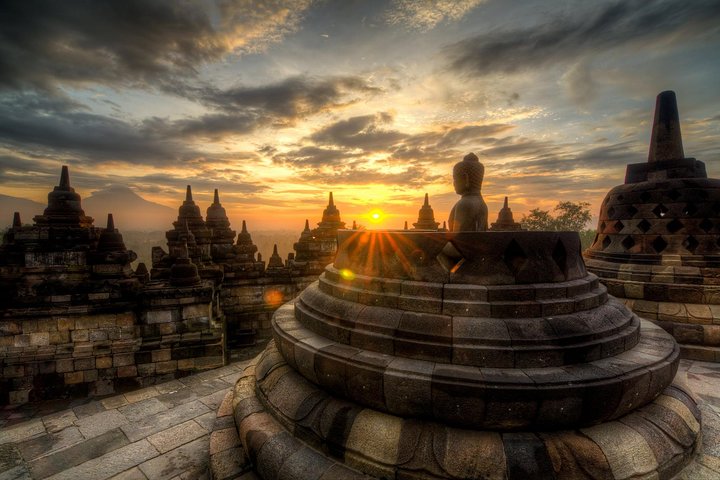
Borobudur Sunrise, Merapi & Prambanan: Full Day
The most-reviewed temple tour I know of. Setumbu Hill at dawn, the Borobudur climb, the Merapi lava tracks, then Prambanan to close. A twelve-hour march, and not for everyone. But if you came for stillness and stone, and you want to earn both temples in a single sweep, this is the day that earns its 4.91 stars.
See dates & prices →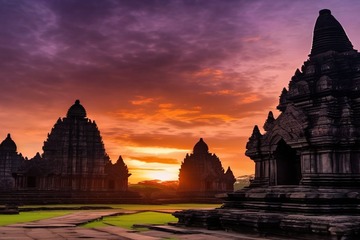
Borobudur Climb, Prambanan & Ramayana Ballet
For the traveller who came for stone and story both. Reads the Hindu epic carved into Prambanan's walls in the afternoon, then watches it danced under the lit spires after dark. If Prambanan reached up like a prayer and you answered, this is your day.
See dates & prices →Explore More
Related comparisons and guides:
Borobudur Sunrise from Setumbu Hill, Merapi Volcano & Prambanan Full Day Tour
★★★★★ 4.9 (1,097 reviews) · From $99
See dates & prices →Borobudur Climb To The Top, Prambanan Temple And Ramayana Ballet
★★★★★ 4.9 (120 reviews) · From $122
See dates & prices →Borobudur Full Climb Up And Prambanan ALL INCLUSIVE PRIVATE Tour
★★★★★ 5.0 (181 reviews) · From $45
See dates & prices →Borobudur ClimbUP guaranteed (sunrise option)& Prambanan Day Tour
★★★★★ 5.0 (164 reviews) · From $325000
See dates & prices →