Merapi is my neighbour. I live in Sleman on her southern slope, and so did the families whose houses you'll see half-buried on the jeep route. In 2010 the mountain killed over three hundred and fifty people and the gatekeeper who refused to leave his post. We don't take her lightly here. So when you ride the lava tour across that black dust, yes, it's an adventure, but the bunker and the little museum of melted belongings are not props. They're memory. Let me be your neighbour for a moment and explain what you are actually going to see, and which of these tours fits the kind of day you came for.
Rama earns a commission when readers book through the Viator links on this site, at no extra cost to the traveller. This does not affect which tours are recommended, every tour passes three checks: guide quality, safety record, and value. Rama does not run a tour company. He does not sell packages.
The Merapi jeep, Borobudur and Prambanan day tour is the one that threads the 2010 pyroclastic track through the bunker and the museum of melted belongings, then takes you to the two UNESCO temples, and it holds a clean 5.0 from every traveller who has ridden it. I will walk you through three more options below, but that is the one I would put my own family in.
My name is Rama Kusuma. The mountain you are paying to visit is the same one I watch from my own front step every morning, the one that decides whether the season's harvest in Sleman is generous or buried. Merapi, the "mountain of fire", sits on the border of the Yogyakarta Special Region and Central Java, and her summit stands somewhere around 2,930 metres, though I say "around" deliberately: every major eruption reshapes the top, knocks the dome down or builds it up, so the number you read this year is not the number from ten years ago. She is monitored every hour of every day by BPPTKG, the volcano observatory, and the area you are allowed into shifts with her alert level. That is not bureaucracy. That is what living beside an active volcano actually means.
This site is not a tour company. I do not run jeeps or sell packages, what I do is read the listings the way a guide reads them and tell you, plainly, which ones fit what you actually came to feel. Merapi is sold hard as a thrill ride, the bouncing 4WD across the lava field, and it is genuinely fun. But if that is all a tour gives you, it has missed the mountain. Below I will explain the lava tour honestly, tell you two stories I carry with me on that route, and then match four day tours to four different kinds of traveller.
What the "lava tour" actually is
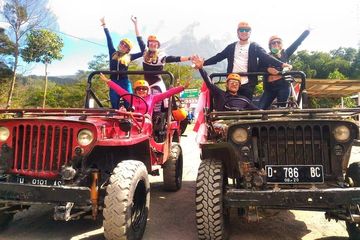
The thing everyone books is the 4WD jeep "Lava Tour," and it runs through the Kaliurang and Kaliadem area on the mountain's southern flank, across the pyroclastic tracks, the wide grey-black valleys that the 2010 eruption scoured and refilled with ash and stone. You are not climbing to the summit. You are riding through the ground the eruption rearranged, and the open-sided jeep bounces you over rutted volcanic dust at a pace that makes children shriek with delight and good shoes weep. Here is the first thing to understand about the money: the jeep is priced per vehicle, not per person. A short route runs around IDR 350,000 for the whole jeep, a longer one IDR 600,000 or more, and each holds about four passengers. A couple pays the same as a group of four, so if you are two, the per-head cost feels steep until you realise you can sometimes share.
The route usually strings together three stops, and these are the heart of it. There is the Kaliadem bunker, a concrete shelter where two people died in an earlier eruption seeking refuge from the heat. There is Museum Sisa Hartaku, the "museum of my remaining belongings", a survivor's house left as the 2010 flow found it, with melted clocks frozen at the hour the cloud came through, scorched motorbikes, cattle bones, a wall of crockery fused into shapes no kiln intended. And there is Batu Alien, the "alien stone," an enormous boulder the 2010 eruption hurled down the valley and dropped where it now sits, far from any mountain it could have broken from. Up above all this is Kaliurang, the old hill resort at around 900 metres, noticeably cooler than the city below, the place Yogyakarta families have always escaped to when the lowland heat becomes too much.
Four Merapi tours, and who each one is really for
Merapi gets sold three ways: as a standalone volcano adventure, as one stop in a marathon temple-and-volcano day, and as part of an adrenaline circuit with the caves to the south. None of these is better than the others, they are different days for different travellers. The mistake is booking the wrong shape and spending your one Merapi morning wishing you had more time, or less. Here is how I match people to each.
If the volcano is the whole point: the private jeep, unhurried
If you came to Yogyakarta and what pulls at you is the mountain itself, not the temples, not a checklist, but Merapi, then book the volcano as its own day, not as something squeezed between two ninth-century ruins. The Private Merapi Volcano 4WD Jeep Tour from Yogyakarta sits at 4.84 stars across 56 reviews, and being private and volcano-only is the entire offer. You are not being rushed off the bunker so the group can make a temple booking. You can stand in the Museum Sisa Hartaku and actually let the melted clocks land on you, ask the keeper his own story, take the longer jeep route if the morning is clear.
Who should skip it? Temple seekers. This is volcano-only, there is no Borobudur, no Prambanan folded in. If your trip has one free day and you have not yet seen the great temples, this is not the tour to spend it on. But if you have the temples handled and the mountain is what you want to feel, this is the day that gives her room.
See dates & prices →
The classic everything-in-one-day: two temples and the volcano
For the first-timer with a single big day who wants to see the three things everyone talks about, this is where most people rightly begin, the Borobudur, Merapi Volcano and Prambanan Temple Private Tour. It runs at 4.85 stars across 102 reviews, it is private so you set the pace, and it threads the Merapi jeep between the two great temples, the Buddhist monument in the morning, the lava field in between, the Hindu spires to close.
his is a packed day. You are covering a Buddhist temple, an active volcano, and a Hindu temple complex that are spread across two regencies, and that means real driving time and a schedule that does not pause for long. It is not the day for lingering deeply at any single stop, if you are the kind of traveller who wants to sit on one terrace until the light moves, this will frustrate you. But if you want to honestly see all three and accept that breadth means you trade away depth, it does the job well.
See dates & prices →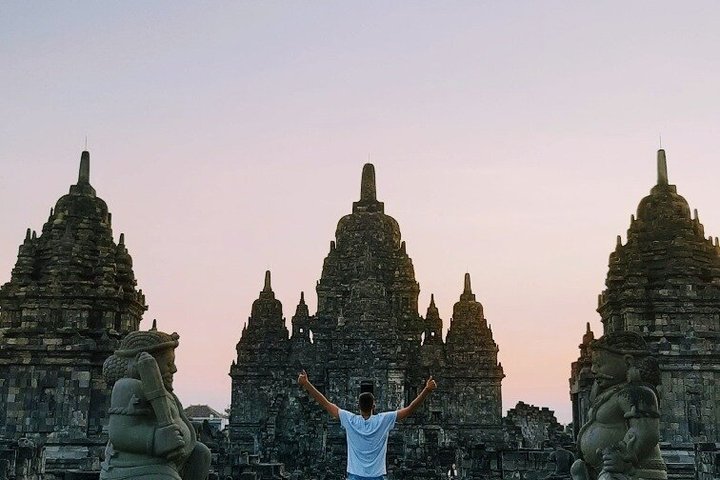
For temple lovers who want the jeep too: the clean-rated combined day
Some travellers want both the carved stone and the black dust but worry about a day that feels thrown together. The Yogyakarta: Borobudur Merapi Jeep & Prambanan Temple One Day Tour carries a clean 5.0 rating, and what I like is how it frames the route, it treats the day as a route through the eighth- and ninth-century Buddhist temple trio alongside the jeep, rather than three unrelated tick-boxes. The framing matters, because a guide who understands how Mendut, Pawon, and Borobudur relate to the situation will also understand why the mountain that fed that situation is part of the same story.
Be honest about two things. The review base is smaller, 33 reviews, so there is less of a crowd's worth of proof behind that perfect score than behind the bigger listings. And confirm before you book whether the Borobudur portion is the climb-to-the-top access or the courtyard view, because "temple tour" can mean either and the difference is real money and a real experience. Ask the operator directly.
See dates & prices →
For the adventure traveller who'd skip temples entirely: volcano sunrise and two caves
Not everyone comes to Java for the temples, and there is no shame in that. If what you want is your body in the situation, height, descent, water, then the Mount Merapi Sunrise, Jomblang Cave and Pindul Cave Tour is built for you. At 4.97 stars across 30 reviews, it strings together a Merapi sunrise, the famous rope descent into the Jomblang sinkhole where a single shaft of light falls into the forest below, and gentle cave tubing at Pindul. It is an adrenaline-first day with no temples at all.
Who should skip it? Temple seekers, plainly, there is no Borobudur or Prambanan here. And anyone uneasy with heights or enclosed space should think hard about the Jomblang portion, because reaching the cave floor means a roughly 60-metre rope descent. If that sentence makes your stomach turn, this is not your tour, and that is a perfectly sensible thing to know about yourself before you book.
See dates & prices →How I choose which Merapi tours to recommend
I apply the same three checks to every tour on this site, in the same order. Here is exactly what each one means at Merapi:
1. Guide quality. At Merapi this matters in a particular way, because the lava tour can be run as pure thrill, bounce the tourists, stop for selfies, collect the fare, or it can be run as memory. I look for operators whose guides know what happened here in 2010, who can tell you whose house the museum was and why the bunker is sacred ground, not a photo backdrop. There is a story I tell about this. In 2016 a young traveller laughed at the spot where Mbah Maridjan, the old gatekeeper, died refusing to abandon his post, she called it superstition. I stopped the jeep. I told her my own family evacuated that year, that this mountain feeds Sleman's soil and takes Sleman's lives in the same breath, and that what she was calling superstition we call memory and respect. She went quiet. At the museum she put her phone away and asked the keeper his own story instead of taking a selfie. A guide who can turn a thrill ride into that is the guide I want you to have.
2. Safety record. This is an active volcano, not a theme park. The jeeps run on rough pyroclastic tracks, and the whole area sits under BPPTKG's monitoring, the permitted radius shifts with the alert level, and a responsible operator respects those zones without argument. I look for operators with sound jeeps, sober drivers, and a flat refusal to push past the safety line for a better photo. The breakdowns happen, these are working vehicles on punishing ground. I was on a jeep in 2023 that stalled deep on a dust track; the young driver, Aan, was mortified. But the jeep being sound enough that we were never in danger, and the driver honest enough not to panic, is exactly the standard I mean. (We used the unplanned twenty minutes well, more on that below.)
3. Value. Not cheapest, value. At Merapi the value question is mostly about the jeep being priced per vehicle, so a tour's real cost-per-person depends entirely on how many seats you fill, and about whether the listing is honest that you are paying for a 4WD lava-field route and not a smooth sightseeing coach. I earn a commission when you book through these Viator links, at no extra cost to you, that's how the site stays free. It does not change which tours pass the three checks, and plenty of well-paying listings never make it onto this page.
Rama's Merapi rules
- The jeep is priced per vehicle, not per head. A couple pays the same as four people, and seats run to about four. If you are travelling as a pair and want to bring the cost down, you can sometimes share a jeep, ask. A short route is around IDR 350,000; a longer one IDR 600,000 or more, for the whole vehicle.
- Bring cash, in small notes. The Merapi sites are cash-only, the bunker, the museum, the parking, the warung selling you a hot drink afterward. There are no cards out here. Carry enough small notes that you are not stuck.
- Wear shoes and clothes you are willing to ruin. The jeep route is black volcanic dust, and it gets into everything. You will come back coated. Leave the white sneakers and the good outfit at the hotel.
- Don't rely on Gojek or Grab out here. The ride-hailing apps get patchy and slow once you are up on the slope. Come with a tour or a hired car-and-driver, and don't assume you can summon a ride back from the mountain.
- Keep within the permitted radius set by BPPTKG. The observatory sets the safe zone according to the mountain's alert level, and it changes. A good guide stays inside it. If anyone offers to take you "closer than allowed" for a better view, that is not bravery, that is someone who has forgotten what 2010 was.
- Bring a layer for the early start, and a little something hot if you can. Kaliurang sits around 900 metres and is cooler than the city; the pre-dawn slope is cooler still. I keep a thermos of ginger tea for the cold morning climbs, the same habit I built for the pre-dawn cold up at Dieng, and I have never once regretted it.
The mistakes I watch travellers make at Merapi
The first is the wardrobe, and it is almost funny until it is yours. People arrive for the lava tour in white shoes and good clothes, as though the jeep were a taxi to a restaurant. The route is black volcanic dust thrown up by four open-sided wheels, and there is no version of this day where you stay clean. I have watched travellers in spotless white sneakers climb back into the jeep at the end of the morning grey to the ankle and quietly heartbroken. Wear what you can ruin. The dust is part of the price.
The second is thinking the jeep tour is like a city sightseeing bus, climate-controlled, smooth, gentle on the spine. It is not. It is rough 4WD across pyroclastic tracks, deliberately so, and that is most of the fun, but if you board expecting a coach you will spend the ride bracing and bewildered instead of laughing. Know what you are getting into and you will love it.
The third is not bringing cash, and I have rescued more than one stranded traveller from it. There are no cards at the Merapi sites, not at the museum, not at the bunker, not at the little stalls. Come with small notes or you will be the person standing at the museum gate unable to pay the entrance you came all this way for.
And the fourth, the one that matters most to me, is not respecting that this is a living, dangerous volcano with real zones drawn around real risk. This is where my second story belongs. In 2023 our jeep stalled deep on a dust track, far from anywhere, and the young driver, Aan, was mortified, apologising, fiddling with the engine, certain he had ruined our morning. I told him to leave it a moment. We had twenty unplanned minutes and a silent valley, so I used them: I showed the guests how the 2010 flow had reshaped that exact valley, where the old riverbed used to run before the eruption rewrote it, how the contour of the land we were stuck in was itself the story. When the jeep finally coughed back to life, the guests said the breakdown spot had given them the finest view of the whole morning. Aan now asks to drive my groups. The point is this: the mountain is not scenery you pass through. She is the thing that made the ground you are standing on, and she can take it back. Treat the bunker and the museum as memory, keep inside the line BPPTKG draws, and Merapi will give you a morning you do not forget, for the right reasons.
Let me leave you with the thing I carry on every jeep I ride. People ask me which is the real Yogyakarta, the temples or the volcano, and which one they should give their day to. I tell them it depends entirely on what you came to feel. The temples are what people built to reach toward the heavens; Merapi is the heaven that does not negotiate, the one my grandparents prayed to and my parents fled from in the same lifetime. There is no winner between stone and fire. There is only the right match between a traveller and a day. Tell me what you came to feel, and the four tours above will sort themselves out.
Explore More
Related comparisons and guides:
Bunker Kaliadem Merapi Car Private Tour Yogyakarta
★★★★★ 5.0 (1 reviews) · From $151
Check Availability →Borobudur, Merapi Volcano and Prambanan Temple Private Tour
★★★★★ 4.9 (103 reviews) · From $50
Check Availability →Private Merapi Volcano 4WD Jeep Tour from Yogyakarta
★★★★★ 4.8 (63 reviews) · From $36
Check Availability →Yogyakarta Private Car Hire with Driver-Custumized Full day Tours
★★★★★ 5.0 (33 reviews) · From $68
Check Availability →Mount Merapi Sunrise , Jomblang cave and Pindul Cave Tour
★★★★★ 5.0 (33 reviews) · From $329000
Check Availability →