My father guided Borobudur for thirty years. When I started at twenty, the first thing he did was take me away from the crowds, down to the hidden base of the temple, the covered Karmawibhangga reliefs that almost no visitor ever sees. He put my hand flat on the stone and told me the carvers buried these panels of cause and consequence on purpose, that some lessons are meant to hold up the whole structure from underneath. I had been rattling off dates and measurements to my groups like a schoolboy reciting a list. That morning I understood the temple is an argument about how to live, not a column of numbers. I have guided these hills ever since, and that lesson sits under everything on this site.
Rama earns a commission when readers book through the Viator links on this site, at no extra cost to the traveller. This does not affect which tours are recommended, every tour passes three checks: guide quality, safety record, and value. Rama does not run a tour company. He does not sell packages.
My name is Rama Kusuma. I live in Sleman, on the southern slope of Mount Merapi, with my wife and two children. I have been guiding the temples and volcanoes of Yogyakarta and Central Java since 2006, twenty years now, and I am a hopeless photography nerd on the side. This site is not a tour company. I do not sell packages or run a fleet of vans. What I do is read the listings the way a guide reads them, and tell you, plainly, which tours fit what you actually came to feel. If you are starting from zero and want the classic three-in-a-day sweep, the most-reviewed full-day Borobudur sunrise, Merapi and Prambanan tour is where most first-timers rightly begin, but read on, because it is a twelve-hour march, and it is not the right day for everyone.
I will tell you now the one word you will never find me use: best. I tell the full story on my about page, but the short version is there is no winner, only the right match between a traveller and a day.
Where most travellers start
Five tours I'd put a friend on. Each one earns its place here on guide quality first, safety second, value third, the same three checks every tour on this site has to pass. Pick the one that feels like your day.
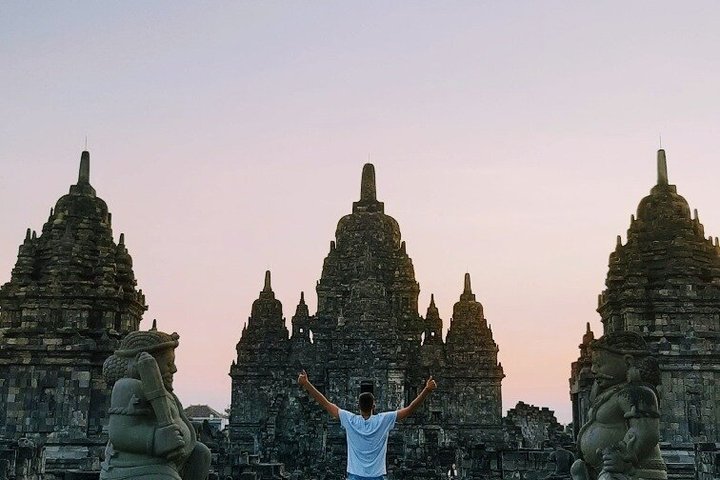
Yogyakarta Private Car Hire with Driver, Customized Full Day Tours
The volcano is my neighbour, and the Yogyakarta Private Car Hire with Driver-Custumized Full day Tours earns its clean 5.0 by threading the 2010 pyroclastic track through the bunker and the museum of melted belongings, then taking you to the two UNESCO temples via Mendut and Pawon. If you want the volcano story without giving up the temples, this is the shape of the day.
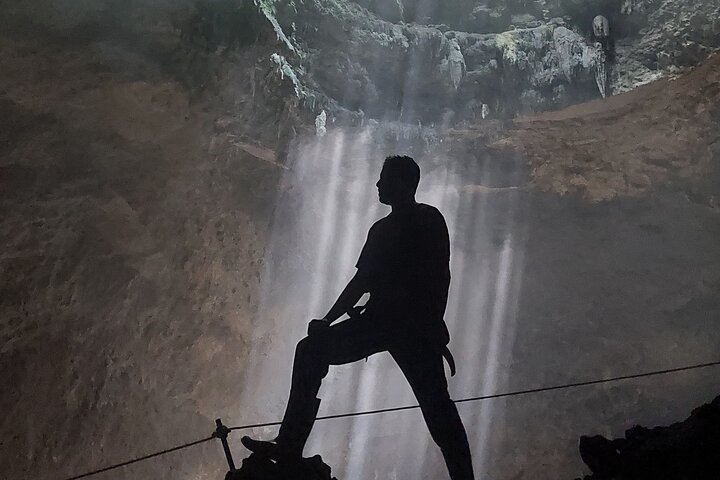
Jomblang & Pindul Caves, with Drone Option
I cannot promise you the Heaven's Light, I say so on every page, but the Yogyakarta Shared Tour: Jomblang & Pindul Cave with DRONE Option gives you the strongest chance. Sixty metres down on a rope into the sinkhole, wait for the beam in the Grubug chamber, then float the underground river on an inner tube. The drone option captures the descent from above. Book the morning slot and watch the forecast.
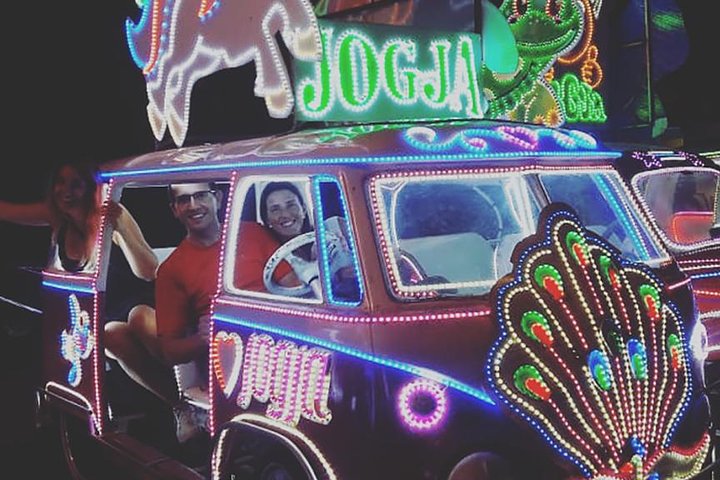
Small-Group Night Food Walk
They call this city Kota Gudeg, and the Small-Group Walking and Food Tour by Night in Yogyakarta is the one I'd send a friend on, capped at eight travellers, angkringan stalls near Tugu station, kopi joss with its glowing charcoal, the real late-night Jogja where students and becak drivers eat. Order a few small plates, sit on the mat, and let the night decide when you're done.
Borobudur Sunrise from Setumbu Hill, Merapi Volcano & Prambanan Full Day Tour
This is the full-day triple header Borobudur, Merapi, Prambanan run by jeep and minivan, starting on Punthuk Setumbu before dawn for the silhouette shot over the Kedu plain, then on to Borobudur courtyard and the climb-to-the-top ticket (booked ahead, since 2023 the terraces need a timed slot), with a jeep loop across the 2010 lava tracks on Merapi's south slope, and Prambanan in the late afternoon when the relief carvings rake sideways and read best. About USD 99 per person, foreign-visitor temple tickets on top (Borobudur courtyard ~IDR 375,000 / ~USD 23, climb ~IDR 455,000 / ~USD 28; Prambanan ~IDR 375,000 / ~USD 23). The day is long, twelve hours plus, with three hours of driving between sites. Not for anyone wanting to linger at one temple.
See dates & prices →Borobudur ClimbUP Guaranteed (Sunrise Option) & Prambanan Day Tour
The point of this one is the ClimbUP guarantee: the climb-to-the-top terrace ticket is bundled in, which is the thing most travellers get turned away from at the gate because the daily quota fills days out. Sunrise is an optional variant; the standard start hits Borobudur early and walks the three upper terraces with the seventy-two perforated stupas before the heat and the bus crowds settle in, then on to Prambanan by early afternoon. Roughly IDR 325,000 per person base, foreigner temple entry extra. Not for anyone who only wants the Setumbu Hill silhouette and doesn't actually plan to climb.
See dates & prices →Borobudur Full Climb Up and Prambanan All-Inclusive Private Tour
Private vehicle, private guide, climb-to-the-top ticket bundled in, and the all-inclusive framing means the entry fees, the upanat woven sandals for the terraces, lunch, and the driver are all on the operator's side rather than itemised at every gate. You cover Borobudur's nine stacked platforms and the inner-balustrade Ramayana reliefs at Prambanan, on your own clock. About USD 45 per person, which lands cheaper than most shared-package Borobudur climbs once the add-ons are tallied. Not for travellers who want a bus full of company; the trade-off for the price is that it is just your group.
See dates & prices →Borobudur Temple Climb To The Top & Prambanan Temple - 1 Day Tour
A straight two-temple day, Borobudur first and Prambanan second, with the climb-to-the-top ticket for Borobudur and the standard entry at Prambanan both handled in advance. You walk the Karmawibhangga-style reliefs on the lower terraces, the narrative Jataka and Avadana panels on the middle ones, and the three circular upper terraces with their seventy-two bell stupas, then cross to Prambanan in the late morning for the 47-metre Shiva temple and the smaller shrines around it. About USD 49 per person, foreigner entry included in most variants. Not for anyone who wants the Setumbu Hill sunrise added; this version skips the pre-dawn stop.
See dates & prices →Borobudur Climb To The Top, Prambanan Temple and Ramayana Ballet
This one stacks Borobudur's upper terraces with a same-evening Ramayana Ballet performance, so the day runs from the early temple hours through to the open-air Trimurti theatre at sunset, with Prambanan itself lit up behind the stage in the dry season (May to October) and shifted to the covered indoor theatre in the wet months. The full Bali-Java Ramayana narrative, gamelan and dancers, plays out in about ninety minutes. About USD 122 per person, foreigner entry and ballet seating tier extra depending on category. Not for anyone planning to do Borobudur at sunrise and the ballet the same night; it is a long day and the early start is fixed.
See dates & prices →Where do you want to go?
Six ways into Central Java. Each one opens to a full hub of honest tour notes, prices, and the mistakes I watch travellers make. Pick the feeling, not the photo.
Borobudur
The largest Buddhist temple in the world, two million stones, no mortar, ninth century. A walk, not a photo stop. Sunrise, the climb ticket, and Setumbu Hill explained honestly.
Prambanan
Indonesia's largest Hindu complex, the Shiva temple soaring 47 metres, the Ramayana carved in stone and danced live in the evening. Walk it from the back to beat the buses.
Merapi
My neighbour. The 4WD lava-tour across the 2010 pyroclastic tracks, the bunker, the museum of melted belongings, Batu Alien. An adventure, but also a place of memory.
Caves
Jomblang's sixty-metre rope descent and the famous Heaven's Light beam, plus gentle Pindul cave-tubing. The one tour where I cannot promise you the magic, and tell you so.
Cycling
The quiet sentence after the grand statements. Rice fields toward the Menoreh Hills, the old Mataram capital of Kotagede, tofu pressed by hand and silver hammered the old way.
Food Tours
They call this 'Kota Gudeg', gudeg city. Night walks through the angkringan stalls, kopi joss with its glowing coal, sate klathak on bicycle spokes, and hands-on cooking classes.
How I choose what to recommend
I have looked at 527 tours across these categories. Most of them never make it onto this site. Every tour I do recommend has to pass three checks, in this order:
1. Guide quality. A tour lives or dies on the person standing in front of you. I look for operators whose guides explain the why, not just the what.
2. Safety record. On a working volcano and on a sixty-metre rope, this is not negotiable. Reputable Merapi operators stay inside the radius set by BPPTKG, the monitoring agency; reputable Ijen operators hand you a gas mask and mean it.
3. Value. Not cheapest, value. The right ticket for the right traveller. Whether the Borobudur climb-to-the-top slot is actually included, or whether you are paying for a courtyard view you thought was the summit.
I earn a commission when you book through the Viator links here, at no extra cost to you. That is how I keep this site free. It does not change which tours pass the three checks, and plenty of well-paying listings don't.
A few things most listings won't tell you
Here is the part the glossy pages skip. Since 2023 you cannot simply wander up Borobudur the way the old postcards show. The terraces now need a separate timed ticket with a small daily quota, special woven 'upanat' sandals to spare the original stone, and a local guide. Foreign courtyard entry runs around IDR 375,000; the climb-to-structure ticket is closer to IDR 455,000. If climbing to the top is your dream, book it days ahead, not at the gate, where I have watched too many travellers learn the word 'sold out' the hard way. And know that Setumbu Hill, the misty sunrise viewpoint four kilometres west, is a completely separate site with its own ticket. The hill photo is not Borobudur access. Plan and pay for both if you want both.
Merapi is my neighbour, and I do not take her lightly. In 2010 the mountain killed over three hundred and fifty people and the gatekeeper, Mbah Maridjan, who refused to leave his post. On the jeep route I always stop at the ground where he died. A young traveller once laughed that it was superstition to stay for a mountain. I told her my own family evacuated that year, that the mountain feeds Sleman's soil and takes lives in the same breath, and that respect here is not superstition but memory. She went quiet, and at the next stop she asked the museum keeper for his story instead of taking a selfie. So when you ride the lava tour across that black dust, wear shoes you can ruin, bring cash because nobody out there takes cards, and treat the bunker and the museum of melted belongings as what they are. Not props. Memory.
And Jomblang, the cave, is the one tour where I cannot promise you the magic, and I would rather say so up front. You harness up, you drop sixty metres on a rope into a green sinkhole, and then you wait in the dark of the Grubug chamber for the sun to do its work. I once took an Australian family down on a grey morning and warned them the Heaven's Light might not show at all. We waited, and just past eleven the clouds tore open and the beam dropped through the cave roof like something poured. The youngest, maybe ten years old, whispered that it looked like the cave was breathing light. I have descended that rope hundreds of times and I still got the chills. But on a cloudy afternoon it is a damp, beautiful, ordinary cave. That is exactly why you book the morning slot days ahead and watch the forecast. Nature does not take reservations.
Rama's quiet rules for a good day
- Read the ticket, not the photo. 'Sunrise from the hill' and 'climb to the top' are two different products at two different prices. Most arguments at the gate start here.
- Carry small cash for Gunungkidul and Merapi. Cave villages, jeep crews, warungs and parking men do not take cards, and the nearest reliable ATM can be an hour back toward the city.
- The jeep is priced per vehicle, not per head. Two people pay the same as four. A couple should join others or simply accept the higher per-person cost, you are not being overcharged.
- Walk Prambanan from the back. Head north to the Sewu Buddhist complex first thing while the buses crowd the Shiva temple, then return an hour later and have the headline almost to yourself.
- Pack a real jacket for the highlands. Dieng and the pre-dawn volcano starts are genuinely cold, single-digit Celsius at 2,000 metres. Tropical Java does not prepare you for it.
- If you book the Bromo–Ijen–Bali run, you end in Bali. Not back in Yogyakarta. Read the ending before you start the trip.
Not sure which way to go? Compare them.
Two questions I get asked more than any other. I wrote these comparison pages so you can settle them before you book.
Borobudur vs Prambanan
Buddhist or Hindu? Inward walk or upward prayer? If you only have time for one great temple, this is how I help travellers decide, and when to just do both on the combined ticket.
Merapi: Jeep vs Hiking
The 4WD lava tour or your own two feet? Which one suits your energy, your time, and what you want from the mountain, without pretending one is the 'winner'.
Multi-Day Volcano Trips
Three days east to Bromo and Ijen, or the gentler Dieng Plateau. The overland runs people remember for years, and how to book the version that ends where you actually need to be.
The Java most visitors drive straight past
If the temples are Java's grand statements, the village cycling is its quiet sentence. We roll out early through the rice fields toward the Menoreh Hills or the old streets of Kotagede, the first Mataram capital, founded in the late sixteenth century, before the heat sits down on the day. We stop where tofu is pressed by hand, where a silversmith still leaves his own mark in the metal because, as one old craftsman told my daughter on a ride through Kotagede, a machine can't. It is flat, it is slow, and it is the Java most temple visitors never see from the main road.
Then there is the food, and the food is where Yogyakarta lets its guard down. They call this city Kota Gudeg, and once you taste the young jackfruit stewed half a day in coconut milk and palm sugar until it turns sweet and brown, you will understand the nickname. But the meal I would actually send you to find is the cheap, late, real stuff, the angkringan stalls near Tugu station serving tiny 'cat-rice' portions and kopi joss, black coffee with a glowing lump of charcoal dropped straight in to cut the acidity. That is where students and becak drivers eat. Order three small plates, sit on the mat, and let the night run long. South of the city, out toward Imogiri, they grill goat satay on iron bicycle spokes instead of bamboo, because the metal carries the heat into the centre of the meat so it cooks evenly with nothing but salt. The first time I explained that to a French guest who had eaten satay across Asia, her 'quick lunch' became two hours and the story of her whole trip. The how is half the flavour.
And if you have three days and a taste for volcanoes, the overland run east is the trip people remember for years. Bromo at dawn, a cone rising out of a sea of sand inside a giant caldera; then Ijen in the small hours, where sulfur burns electric blue in the dark and miners haul yellow slabs up from a turquoise acid lake by hand. It can end with a ferry to Bali if that is where you are headed next. Just book the right version, I have met travellers who chose the Bali drop-off and then needed to be back in Yogyakarta, stranded on the wrong side of Java with a flight to catch.
Twenty years on these temples, and my father's thirty before me, taught me one thing above all: the right day in Yogyakarta is the one matched to what you actually came to feel, quiet and old, or high and wild, or slow and local. Tell me which, and the pages on this site will tell you straight which tours fit and which to skip. Before he passed in 2020, my father climbed Borobudur with me one last quiet morning, slower than he used to, leaning on the warm stone. He didn't recite a single fact. He just watched the light fill the valley he had guided for thirty years and told me the temple would outlast both of us, and the only thing we ever leave in it is how we made people feel. I carry that up every dawn I work. I hope it carries you somewhere good too.
Explore More Yogyakarta Comparisons
Small-Group Walking and Food Tour by Night in Yogyakarta
★★★★★ 5.0 (337 reviews) · From $575000
See dates & prices →Borobudur Sunrise from the Hill, Merapi Volcano & Prambanan Tour
★★★★★ 5.0 (4 reviews) · From $114
See dates & prices →Borobudur Sunrise from Setumbu Hill, Merapi Volcano & Prambanan Full Day Tour
★★★★★ 4.9 (1,097 reviews) · From $99
See dates & prices →Borobudur Climb To The Top, Prambanan Temple And Ramayana Ballet
★★★★★ 4.9 (120 reviews) · From $122
See dates & prices →Borobudur Temple Climb To The Top & Prambanan Temple - 1 day tour
★★★★★ 4.9 (673 reviews) · From $49
See dates & prices →Borobudur Full Climb Up And Prambanan ALL INCLUSIVE PRIVATE Tour
★★★★★ 5.0 (181 reviews) · From $45
See dates & prices →Yogyakarta Private Car Hire with Driver-Custumized Full day Tours
★★★★★ 5.0 (33 reviews) · From $68
See dates & prices →Yogyakarta Shared Tour: Jomblang & Pindul Cave with DRONE Option
★★★★★ 5.0 (30 reviews) · From $375000
See dates & prices →Borobudur ClimbUP guaranteed (sunrise option)& Prambanan Day Tour
★★★★★ 5.0 (164 reviews) · From $325000
See dates & prices →