Rama earns a commission when readers book through the Viator links on this site, at no extra cost to the traveller. This does not affect which tours are recommended, every tour passes three checks: guide quality, safety record, and value. Rama does not run a tour company. He does not sell packages.
I grew up watching my father guide this hill, so let me be straight with you: Borobudur is not a photo stop, it is a walk. You enter at the bottom among carved scenes of ordinary human desire and you climb, terrace by terrace, until the carvings fall away into seventy-two bare stupas and open sky. Two million andesite blocks, no mortar, the joints simply interlocking the way the Sailendra masons cut them twelve hundred years ago, but the numbers are not the point. The point is that the people who built it wanted your body to feel the climb, not just your eyes to see a monument. Go slowly. The temple is patient; it waited a thousand years under the ash for you. If climbing to those seventy-two stupas is your dream, the guaranteed ClimbUP tour (4.96★) locks your summit slot in writing. But read on, because the quota catches more travellers than any other single thing at this temple.
My name is Rama Kusuma. I live in Sleman, on the southern slope of Merapi, about forty kilometres southeast of Borobudur, and my father guided this temple for thirty years before me. The lesson he taught me, pressing my hand flat against the hidden Karmawibhangga stone, is on my about page in full. Everything on this page comes out of that one lesson.
This site is not a tour company. I do not run vans or sell packages. What I do is read the listings the way a guide reads them and tell you which ones fit what you actually came to feel. Borobudur is the most photographed thing in Central Java and also the most misunderstood at the booking stage, because the single most important question (will I actually be allowed to climb to the top?) is buried in fine print or left out entirely. So before we get to the tours, let me explain what has changed at the temple, and then I will tell you, plainly, which of four day tours suits which kind of traveller.
What the old postcards don't tell you anymore
The image you have in your head, visitors strolling freely up to the great central stupa, sitting among the bell-shaped terraces at dawn, is from a Borobudur that no longer exists for most people. Since 2023, climbing the upper terraces requires a separate timed ticket with a small daily quota, a local guide, and special woven upanat sandals to spare the ninth-century stone from twelve hundred years' worth of modern shoe soles. The foreigner courtyard ticket, which lets you walk the grounds and see the temple from below, runs around IDR 375,000, roughly twenty-three US dollars. The climb-to-the-structure ticket, the one that actually gets your feet on the terraces, is closer to IDR 455,000, about twenty-eight dollars. The gates open around half past six and the site closes by half past four.
That quota is the single thing that catches the most travellers, and it is why so much of this page comes back to it. The daily cap fills early. I have stood at the gate and watched couples who flew across the world realise that "we'll just buy the climb ticket when we get there" was a mistake, the climb slots were gone by mid-morning and they were left with a courtyard view of a temple they could not enter. If climbing to the summit is the whole point of your day, the guaranteed ClimbUP tour locks your slot in writing and removes the quota gamble entirely. Book the climb-to-the-top ticket online, days ahead. This is not me upselling you. This is me trying to keep you off the wrong side of that fence.
Four Borobudur tours, and who each one is really for
Almost every Borobudur day tour pairs the temple with Prambanan, and the better ones fold in either Setumbu Hill at sunrise or Mendut on the way in. The difference between them is not quality, all four below are excellent. The difference is the shape of your day: how early you rise, how much you cram in, and whether the climb is guaranteed or left to the quota. Here is how I match travellers to each.

The classic first-timer's sweep: sunrise, volcano, and two temples
If you have one big day in Yogyakarta and you want to see everything everyone talks about, this is where most first-timers rightly begin, the Borobudur Sunrise from Setumbu Hill, Merapi Volcano & Prambanan full-day tour. It is the most-reviewed Borobudur tour I know of, sitting at 4.91 stars across more than a thousand travellers, and it earns that. You start in the dark on Setumbu Hill watching the mist lift off the Kedu plain with the temple as a silhouette, then come down for the Borobudur climb (the listing states the climb ticket is included, read on, I'll come back to that), then the Merapi lava country near my own home, then Prambanan to close.
Here is his is a twelve-hour day that begins with a pickup before dawn, and remember, sunrise tours quote you the pickup time, not the start time. A 3:30 pickup means an hour-plus drive in the dark before you see anything. It is glorious if you have the legs for it. If you tire easily, or you are travelling with small children or elderly parents, this is not your day, you will be exhausted by Prambanan and resent the thing you came to love.
See dates & prices →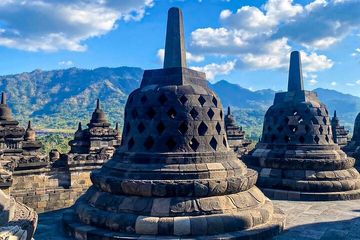
If the climb is the whole point: the guaranteed-access tour
Everything I said about the quota, the couples turned away at the gate, is exactly why this one exists. The Borobudur ClimbUP guaranteed (sunrise option) & Prambanan day tour carries the highest rating I've seen for a Borobudur trip, 4.96 stars, and it does the one thing that matters most: it guarantees your capped climb-to-the-top slot in writing, with a sunrise option on top. No quota gamble, no standing at the counter hoping. For the traveller whose single non-negotiable dream is to stand among the seventy-two stupas at the summit, this removes the exact risk that ruins people's mornings.
Who should skip it? If you only want courtyard photographs of the temple from below, the wide shot everyone recognises, then you are paying for access you won't use. The guaranteed climb is a premium for a specific desire. Be honest with yourself about whether the summit is the thing, or whether the view of the temple is enough.
See dates & prices →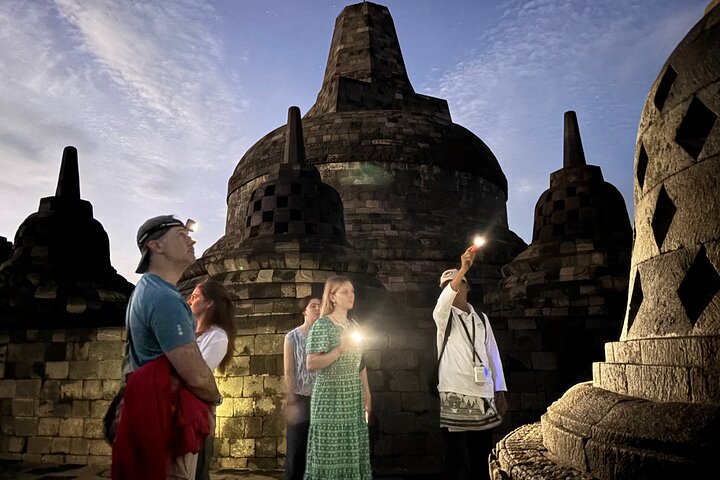
For couples and families who hate being rushed: private and flexible
Some travellers do not want to keep a group's pace, and at the temples I understand it completely. The Borobudur Full Climb Up and Prambanan all-inclusive private tour is also at 4.96 stars, and being private is the whole offer, you set your own schedule and linger as long as you like at each site. If you are the kind of person who wants to stand at the Karmawibhangga base and actually read a few panels, or sit on a terrace until the light moves, this is the day that lets you. Families with kids who need a snack and a slower morning will breathe easier here too.
The trade-off is plain: private pricing is far higher per head than a shared tour. A solo budget traveller will pay for empty seats. But split between two or four people who value setting their own pace, it stops being extravagant and starts being the sensible choice.
See dates & prices →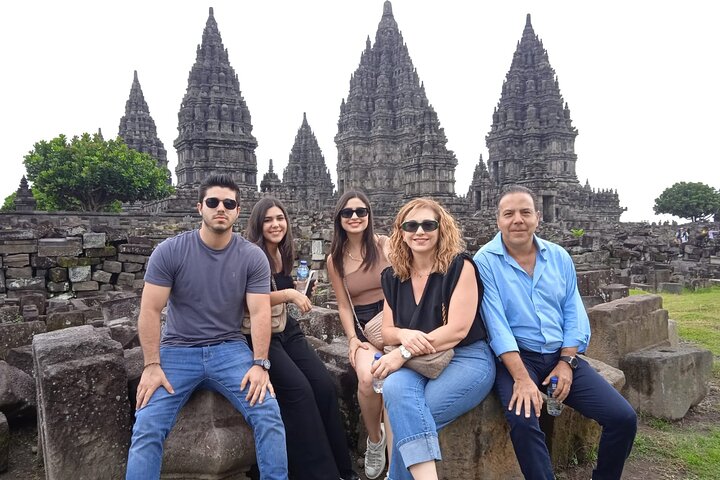
For temple lovers who'd skip the volcano: two, really three, temples, done deep
Not everyone wants Merapi in the same day, and honestly, racing from a volcano back to a temple is how people end up remembering the traffic instead of the stone. The Borobudur Temple Climb to the Top & Prambanan one-day tour trims the volcano and gives that time back to the temples, 4.93 stars across more than six hundred and sixty reviews, so the proof is deep. What I like most is that it adds Mendut, three kilometres east of Borobudur, the oldest Buddhist temple in this little group, with its magnificent three-metre seated Buddha flanked by two bodhisattvas. Most tours drive straight past it. This one stops.
It is not for you if seeing Merapi the same day is on your list, this tour deliberately leaves the volcano out to buy you more time among the carvings. But if you came for the temples themselves, this is the day with room to breathe.
See dates & prices →How I choose which Borobudur tours to recommend
I apply the same three checks to every tour on this site, in the same order. Here is exactly what each one means at Borobudur:
1. Guide quality. At Borobudur this matters more than almost anywhere, because the temple is a story carved in stone and a bad guide reduces it to dates. I look for operators whose guides walk you through the reliefs clockwise, pradaksina, the way the temple is meant to be read, and explain that you are climbing from the world of desire at the base toward formlessness at the open summit. A guide who only points and names is selling, not teaching. I learned that distinction the hard way: for nearly ten years I explained one relief as a shipwreck, until an archaeologist on my tour corrected me, gently, it was a different voyage tale entirely. I stopped the group and told them I had been wrong for a decade. My father taught me that a guide who cannot say "I was wrong" is selling, not teaching. So I trust operators whose guides know the stone deeply enough to be corrected by it.
2. Safety record. Borobudur is gentler than a volcano or a sinkhole rope, but the sunrise starts mean long pre-dawn drives on dark roads, and the upper terraces are steep ninth-century steps now climbed in soft upanat sandals. I look for operators with proper drivers, sane schedules, and respect for the quota system rather than ones who promise climb access they cannot actually deliver.
3. Value. Not cheapest, value. At Borobudur this check is almost entirely about one question: does the price include the climb-to-the-top ticket, or only courtyard entry? The cheap "sunrise" packages are frequently a Setumbu Hill view with no temple-summit access at all, and travellers don't discover the gap until the gate. The tours above pass this check because what they include is stated plainly. I earn a commission when you book through these Viator links, at no extra cost to you, that's how the site stays free. It does not change which tours pass the three checks, and plenty of well-paying listings never make it onto this page.
Rama's Borobudur rules
- Book the climb-to-the-top ticket online, days ahead. The daily quota is small and fills early. Turning up hoping to climb usually means a courtyard ticket and a view from below, not the summit you flew here for.
- Setumbu Hill and the Borobudur climb are two separate sites with two separate tickets. Setumbu is a sunrise viewpoint four kilometres west, around IDR 60,000 for foreigners, with no temple access at all. Paying for the hill does not get you onto the terraces. Plan and pay for both if you want both.
- On a clear dry-season morning, skip Setumbu and shoot from the temple terraces themselves. The light hits the stupas directly up there. Save Setumbu for misty mornings, when you want the temple as a silhouette with the volcanoes behind it. Different weather, different choice.
- If you're doing Prambanan too, buy the combined Borobudur + Prambanan ticket. It's valid across both within 48 hours and it's cheaper, but operators and counters rarely volunteer it. Ask for it by name.
- Sunrise tours quote the pickup time, not the start time. A 3:30 pickup means an hour-plus drive in the dark before anything happens. Eat something first, nothing is open out there, and bring a layer; the pre-dawn Kedu plain is cooler than tropical Java leads you to expect.
- For any trip beyond the city ring road, hire a car and driver rather than relying on Gojek or Grab. The ride-hailing apps get patchy and expensive out at the temples, and you'll wait a long time for a car back. A hired car-and-driver for the day usually works out cheaper and far less stressful.
The mistakes I watch travellers make at Borobudur
The first and most painful is expecting to walk up freely, the way the old photographs show. People arrive with that postcard in their heads and learn at the gate that since 2023 the terraces need a capped, timed ticket they should have booked online. I have stood beside more than one couple as that realisation lands, and there is nothing I can do for them at that point, the day's quota is simply gone. Book ahead. I cannot say it enough.
The second is treating Setumbu Hill as if it were "inside" Borobudur. Travellers pay the small fee for the sunrise hill, feel they've handled their ticket, and are then blindsided by the much larger temple entry as a separate cost, or worse, discover too late that their cheap "sunrise package" was the hill view only and never included temple access at all. Read what "climb to the top" versus "sunrise from the hill" actually means in your listing. They are two different products at two very different prices, and most arguments at the gate start right here.
The third is over-stuffing the day. Every season someone tells me they want to "do" Borobudur, Merapi, and Prambanan as a relaxed outing. It is not relaxed, it is a twelve-hour march, and if you add a pre-dawn Setumbu start you are awake for sixteen. There is no shame in choosing the two-temple day instead and giving the stone the time it deserves. The temples reward slowness, not mileage.
And the fourth, quietly, is rushing past meaning to chase the trophy shot. The most photographed corner of Borobudur is the same one everyone fights over at dawn, and people queue for a picture they could find anywhere instead of walking the reliefs that make the temple what it is. A few years ago I pulled my group over on the Mendut–Borobudur road and showed them how Mendut, Pawon, and Borobudur fall on an almost perfect straight line, many believe it was intentional, ceremonial, a processional path. One traveller scoffed that it was coincidence. I told him the people who hauled two million stones into place without a drop of mortar did not do much by accident. His whole posture changed. That is the temple I want you to meet, the one that was built as an argument, not a backdrop.
Let me leave you with the thing I carry up every dawn I work. There is no best temple, as I explain on my about page, Prambanan reaches up like a prayer and Borobudur asks you to walk inward. There is only the right match between a traveller and a day. Tell me what you came to feel, and the four tours above will sort themselves out.
Explore More
Related comparisons and guides:
Borobudur Sunrise from setumbu Hill , Merapi Volcano & Prambanan Full Day Tour
★★★★★ 4.9 (1,097 reviews) · From $99
Check Availability →Borobudur Temple Climb To The Top & Prambanan Temple - 1 day tour
★★★★★ 4.9 (673 reviews) · From $49
Check Availability →Borobudur Full Climb Up And Prambanan ALL INCLUSIVE PRIVATE Tour
★★★★★ 5.0 (181 reviews) · From $45
Check Availability →Borobudur ClimbUP guaranteed (sunrise option)& Prambanan Day Tour
★★★★★ 5.0 (164 reviews) · From $325000
Check Availability →