Rama earns a commission when readers book through the Viator links on this site, at no extra cost to the traveller. This does not affect which tours are recommended, every tour passes three checks: guide quality, safety record, and value. Rama does not run a tour company. He does not sell packages.
If you have three days and a taste for volcanoes, the overland run east is the trip people remember for years. Bromo at dawn, a cone rising out of a sea of sand inside a giant caldera; then Ijen in the small hours, where sulfur burns electric blue in the dark and miners haul yellow slabs up from a turquoise acid lake. It ends with a ferry to Bali if that's where you're headed. The Bromo sunrise, Ijen blue fire and Bali drop-off tour is the strongest option, 4.99 stars across more than a hundred travellers, small-group, and it handles both volcanoes and the ferry crossing in three days. Just book the right version, I've met travellers who chose the Bali drop-off and then needed to be back in Yogyakarta, stranded a full day's drive on the wrong side of Java with a flight to catch. That single booking choice is the most expensive mistake on this whole page, and it's the easiest one to avoid.
My name is Rama Kusuma, and I guide out of Sleman, on the slope of Merapi. Most of this site is about the temples and volcanoes you can see in a single day from Yogyakarta. This page is different, it's about the trips that take you beyond the city's reach, the ones that need real time and real planning, because the volcanoes east of here are too far and too demanding to fold into a day. I've ridden these routes, slept the broken pre-dawn sleep they ask of you, and watched both the magic and the misery they can produce. Below I'll lay out what's actually out there, tell you two stories I carry from the road east, and then match four multi-day itineraries to four different kinds of traveller.
This site is not a tour company. I don't run jeeps, I don't sell packages, and I don't operate the overland trips below. What I do is read the listings the way a guide reads them and tell you, plainly, which ones fit what you actually came to feel, and, on this page especially, where you're actually flying home from. With multi-day trips that last question matters more than any star rating, so I'll keep returning to it. Get the endpoint right and these are the finest days you can spend in Java. Get it wrong and the trip becomes a logistics nightmare no scenery can fix.
What's actually out there, east and west
The headline trip runs east from Yogyakarta into East Java, and it strings together two volcanoes that could not be more different. First is Mount Bromo, 2,329 metres, sitting inside the vast Tengger caldera, an ancient collapsed crater so wide it holds a plain the Tenggerese call the Sea of Sand. The classic experience is the sunrise: you climb in the dark to a viewpoint like Penanjakan or King Kong Hill and watch dawn break across that sea of sand with Bromo's active, smoking cone rising out of it. Then you cross the volcanic sand plain on foot or by jeep and climb a staircase to the crater rim itself, to stand at the edge of a vent that is very much alive. The road leg from Yogyakarta alone is a long one, roughly eight to ten hours of driving, which is exactly why this can't be a day trip.
The second volcano is Kawah Ijen, around 2,769 metres, near Banyuwangi at the far eastern tip of Java. Ijen is famous for two things that don't exist together anywhere else I know. The first is the blue fire, sulfuric gas escaping from vents and burning electric blue, but visible only in true darkness, which is why the hike starts at one or two in the morning. The second is what you find at the summit: the world's largest highly acidic crater lake, a turquoise expanse so corrosive it would strip the flesh from your hand, and it's worked by sulfur miners who break slabs of yellow sulfur loose by the vents and haul them up and out by hand, eighty kilos and more on a shoulder yoke. Ijen demands a gas mask near the blue-fire vents, the sulfur fumes are genuinely hazardous, not a formality, and I'll come back to that, because there's a story I need you to hear before you go.
The standard route ties these together: Yogyakarta → Bromo → Ijen → Bali over three days, ending at Ketapang harbour in Banyuwangi for the short ferry crossing to Bali. Some longer itineraries add Tumpak Sewu, a wide, tiered curtain waterfall that falls in a great horseshoe, a worthy detour if you have the days for it. And then there's the trip that goes the other way, west and up, to the Dieng Plateau.
Dieng sits at around 2,000 metres in the highlands, and it's a quieter, older kind of place. The Arjuna temple complex there holds some of the oldest surviving Hindu temples in Java, seventh and eighth century, which means they predate Borobudur and Prambanan both. There's Sikunir Hill, climbed in the dark for what's marketed as the "Golden Sunrise" over a sea of cloud; Telaga Warna, the Colour Lake, which shifts its hue as dissolved sulfur catches the light; and Sikidang, a bubbling, hissing crater you can walk right up to. The one thing every brochure underplays: Dieng is genuinely cold. Nights drop to single digits Celsius. People arrive dressed for tropical Java and spend the dawn shaking. I'll tell you that story too.
Four multi-day trips, and who each one is really for
Multi-day trips get sold as one glossy adventure, but they are not interchangeable, and the differences are the whole game. One ends in Bali. One ends in Bali too, but private. One never leaves the highlands and never asks you to commit beyond a day. And one stretches the whole Java-to-Bali story across five unhurried days. None is better than the others, the right one depends entirely on how much time you have and, above all, where you need to be when it's over. Here's how I match people to each.
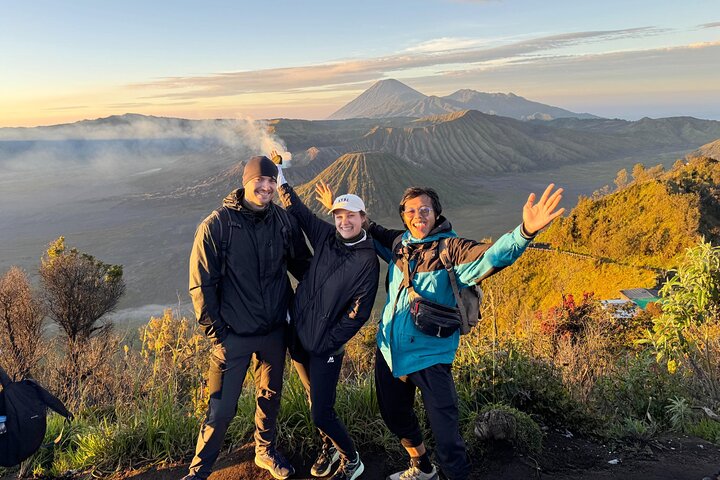
For the traveller who wants ancient highlands, not a marathon east: Dieng
Not everyone has three days, and not everyone wants to wake at one in the morning to crouch by a sulfur vent. If what pulls at you is something older and quieter, the oldest Hindu temples in Java, a sunrise over a sea of cloud, a cold highland morning, then the From Yogyakarta: Dieng Plateau Golden Sunrise Private Day Trip is built for you. It holds a 5.0 rating, it's genuinely off the beaten track, and it threads the Sikunir golden sunrise together with the Arjuna temple complex and the coloured crater lakes, all with no multi-day commitment, because it returns you to Yogyakarta the same day.
Who should skip it? Volcano seekers chasing Bromo and Ijen, those are in the opposite direction, and Dieng is a different, gentler kind of high place. And do not underestimate the cold: this is a pre-dawn climb at 2,000 metres where mornings hit single digits. Come dressed for it or the magic will be lost behind your shivering. More on that below, it's a story I've earned.
See dates & prices →Want the full volcano loop? Start here
Every Bromo–Ijen tour on Viator ends in Bali, no round-trip to Yogya exists. This small-group trip is the best-reviewed way to do it, with 109 travellers averaging 4.99 stars. If you're heading to Bali next, it's the natural choice. If your flight's from Yogya, budget the long drive back.
How I choose which multi-day trips to recommend
I apply the same three checks to every tour on this site, in the same order. Here is exactly what each one means for the multi-day trips east and to Dieng:
1. Guide quality. On these trips the guide and driver carry more of the day than anywhere else, because so much of it is dark, cold, and physically demanding. At Ijen especially, a good guide insists on the gas mask, reads the wind, and knows to follow the miners' lead near the vents. There's a story I carry from Ijen in 2023. A traveller pulled his mask off to film the blue flames, walked straight into a shifting gust of sulfur gas, and doubled over coughing, couldn't breathe. A miner who'd just hauled eighty kilos of sulfur up out of that crater dropped his read on the situation in an instant, grabbed the man's arm, and walked him upwind without a single word. The man recovered. My own guest, watching it, emptied his pockets into that miner's hands as a tip and didn't take another photograph the rest of the morning without asking first. The lesson I took, and the one I want any guide of yours to carry: on a working volcano, follow the people who work it. Their read of the mountain outranks any itinerary.
2. Safety record. Ijen is the sharpest case I know. The sulfur fumes near the blue-fire vents are genuinely hazardous, this is not theatre, and a responsible operator provides a proper gas mask, briefs you to keep it on, and turns you back when the gas is bad. The long road legs matter too: eight to ten hours each way to Bromo means I want sober drivers, sound vehicles, and a schedule that builds in rest rather than pushing through the night on willpower. I look for operators who treat the mask, the wind, and the driver's fatigue as non-negotiable, not as things to economise on.
3. Value. Not cheapest, value. On multi-day trips the biggest value question isn't price at all; it's whether the itinerary actually ends where you need to be. A trip that drops you in Bali is superb value if you're going to Bali and a catastrophe if you're flying home from Yogyakarta. After that comes the honest stuff: shared versus private on those long legs, three days versus five, how much the early starts ask of you. I earn a commission when you book through these Viator links, at no extra cost to you, that's how the site stays free. It does not change which tours pass the three checks, and plenty of well-paying listings never make it onto this page.
Rama's multi-day rules
- Book the drop-in-Bali version only if you actually want to end in Bali. This is the one that catches people. The Bromo-Ijen overland trips end at Banyuwangi or across the water in Bali, not back in Yogyakarta. If you're flying home from Yogyakarta or Solo, the Bromo–Ijen small-group tour drops you in Bali (ideal if continuing east), but true round-trip back to Yogya doesn't exist on Viator, check the endpoint before you book.
- The gas mask at Ijen is not a souvenir prop. Wear it near the blue-fire vents, keep it on, stay upwind, and follow the miners' read of the wind, they live by it. The sulfur gas is genuinely dangerous, and the worst moments I've seen on that mountain all started with someone pulling the mask off for a photo.
- Dieng is cold, bring a real jacket. Single-digit Celsius mornings at 2,000 metres are normal, not freak weather. Shorts and a t-shirt will leave you shaking through the sunrise you came for. Pack a proper layer.
- Bromo's pre-dawn is cold too. The sunrise viewpoints sit high and exposed, and you'll be standing still in the dark waiting for the light. A warm layer, a hat, gloves if you feel the cold, you'll want all of it.
- If you're returning to Yogyakarta, plan your endpoint carefully. No Viator product loops back to Yogya from Bromo–Ijen, all end in Bali. The small-group 3-day trip is the best-reviewed option. If your flight is from Yogya, budget a long drive back or book a one-way flight from Bali.
- I never climb a cold dawn hill without a thermos. Ginger tea, hot, carried up in the dark, it's the small thing that turns a shivering wait into a memory. I built the habit at Dieng and I've never broken it. Bring your own if your guide doesn't.
The mistakes I watch travellers make on multi-day trips
The first is the one I keep hammering, because it's the most painful and the most avoidable: booking a "Bromo Ijen Bali" trip while planning to fly home from Yogyakarta. The drop-off is in Banyuwangi or across the strait in Bali, and people only realise mid-trip that there's no built-in way back. I've watched a traveller work it out at breakfast on day two, the slow, sinking understanding that his flight left Yogyakarta the next evening and he was about to be delivered to the far eastern end of the island. He spent the money he'd saved on the trip, and more, on a frantic same-day drive back across Java. Read the endpoint before you pay. Always.
The second is at Ijen, and it can hurt you: climbing toward the blue fire without the gas mask actually on your face. People treat it as a costume piece, push it up onto their forehead for a clearer photo, and then the wind shifts. This is where my Ijen story belongs. In 2023 a man on a trip near mine pulled his mask off to film the flames, caught a shifting gust of sulfur gas full in the lungs, and folded over coughing, unable to draw breath. It was a sulfur miner, a man who had just carried eighty kilos of the stuff up out of that crater on his own shoulders, who saw it instantly, took the stranger's arm, and walked him upwind to clean air without a word, then turned and went back to his load. My guest who saw it tipped that miner everything in his pocket and didn't take another photo all morning without asking. Follow the people who work the mountain. Their read of the wind outranks your shot.
The third is underdressing for the cold, shorts and flip-flops at 2,000 to 2,900 metres, in the dark, before the sun. People plan for tropical Java and forget that altitude rewrites the rules. Here's the story I've earned on this one. In 2023 a couple from Singapore booked Dieng dressed for the lowland heat, and at 2,000 metres before dawn they were shaking so hard they could barely speak. I keep a thermos of ginger tea for exactly this, so I shared it with them as we climbed Sikunir in the dark. When the sun finally broke over that sea of cloud, the husband told me the cold had made the warmth of the moment sharper, that he'd never have felt it so clearly if he'd been comfortable. A lovely thing to say, and true. But I'd rather you brought a jacket and felt the sunrise without the suffering. I've never guided Dieng without that thermos since.
And the fourth is quieter, and it's the one I care about most: photographing the Ijen sulfur miners as scenery and walking past. These are men doing some of the hardest, most dangerous work in Indonesia, breaking sulfur loose by hand in toxic air and carrying staggering loads up out of an acid crater, for very little. They are not part of the view. Don't shove a lens in a man's face mid-haul and move on as though he were a smoking vent. Ask. Buy a carved sulfur trinket from him, tip him, look him in the eye. The mountain gives you a spectacle; the least you can do is treat the people who work it as people.
Let me leave you with the thing I tell everyone weighing one of these trips. The multi-day run east is the most memorable thing you can do from Yogyakarta, Bromo's cone in the dawn light, Ijen's blue fire in the dark, the ferry pulling away toward Bali. There's no winner among the four trips above; there's only the right match between a traveller, the days they have, and where they need to be when it's over. So before you fall for the photographs, answer the unglamorous question first: where are you flying home from? Get that right, dress for the cold, keep the mask on, and follow the people who work these mountains. Do that, and this is the trip you'll still be telling people about years from now.
Explore More
Related comparisons and guides:
From Yogyakarta to Bali : Bromo and Kawah Ijen in 3 Day Adventure
★★★★★ 5.0 (6 reviews) · From $5490000
Check Availability →From Yogyakarta: Mount Bromo Sunrise and ijen crater Blue Fire - 3 Days
★★★★★ 4.8 (16 reviews) · From $369
Check Availability →From Yogyakarta: Tumpak Sewu Bromo and Ijen with Bali Drop-off
★★★★★ 5.0 (4 reviews) · From $3850000
Check Availability →From Yogyakarta: Bromo Sunrise & Ijen Volcano with Bali Drop-off
★★★★★ 5.0 (110 reviews) · From $375
Check Availability →From Yogyakarta: Dieng Plateau Golden Sunrise Private Day Trip
★★★★★ 5.0 (14 reviews) · From $81
Check Availability →