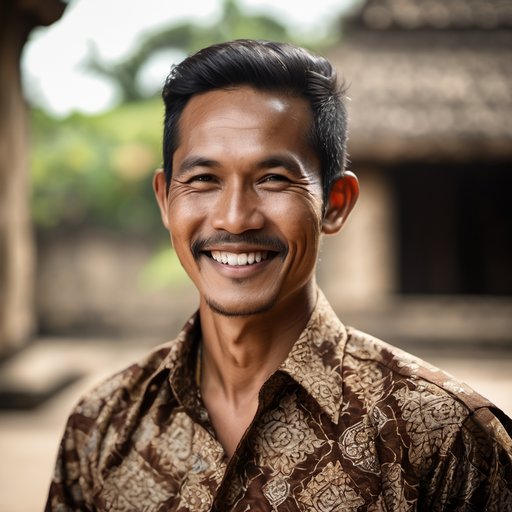
Rama earns a commission when readers book through the Viator links on this site, at no extra cost to the traveller. This does not affect which tours are recommended, every tour passes three checks: guide quality, safety record, and value. Rama does not run a tour company. He does not sell packages.
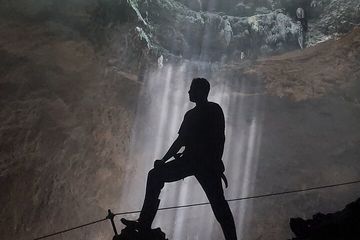
Let me be honest with you before you book anything, because the caves are the one corner of my region where the booking pages over-promise the most. The Jomblang and Pindul caves shared tour, sixty metres down on a rope into the sinkhole, then floating the underground river on an inner tube, holds a perfect 5.0 and gives you the strongest chance at the Heaven's Light beam, because the operator handles the tight morning-slot timing routinely. Jomblang is the one tour where I cannot promise you the magic, and I'd rather say so. You use up, you drop sixty metres on a rope into a green sinkhole, and then you wait in the dark of the Grubug chamber for the sun to do its work. On a clear morning around eleven, a single beam falls through the cave roof and the whole cavern seems lit from heaven. On a cloudy afternoon, it's a damp, beautiful, ordinary cave. That's why you book the morning slot days ahead and watch the forecast. Nature doesn't take reservations.
My name is Rama Kusuma. I live in Sleman, on the southern slope of Merapi, but the caves pull me about two hours southeast into Gunungkidul, a different Java entirely. Where my home is volcanic, black soil and ash, Gunungkidul is karst: grey limestone country, riddled underneath with caves and underground rivers, the same stone that drops away to the wild southern beaches a little further on. The whole district is honeycombed. Goa Jomblang and Goa Pindul sit within the same limestone, a short drive apart, and that is why almost every cave tour from Yogyakarta pairs them, the vertical drama of one against the gentle float of the other.
This site is not a tour company. I do not run vans or sell packages, what I do is read the listings the way a guide reads them and tell you which ones fit what you actually came to feel. The caves need that reading more than the temples do, because the single most important fact about Jomblang, that the famous light is a weather-and-timing gamble with a tiny daily cap on who even gets to descend, is rarely stated plainly on the booking page. So before we get to the four tours, let me tell you exactly what these two caves are, and then I will match each tour to the kind of traveller it actually suits.
What the brochures don't tell you about the light
Goa Jomblang is a collapse-doline, a vertical sinkhole where a chunk of the cave roof fell in long ago, leaving a shaft of forest sunk into the limestone near Semanu, about an hour and a half to two hours southeast of the city. You do not walk into Jomblang. You are clipped into a use and lowered roughly sixty metres on a single rope, with a belay crew managing your descent, into an ancient sunken garden the locals call the "forest of antiquity." From there you walk through to the larger Grubug chamber, and that is where the famous thing happens, or doesn't. Cahaya Surga, Heaven's Light: a single shaft of sun that pierces a gap in the cave roof and lands on the chamber floor, most reliably between ten and noon on a clear day. Past midday, or under cloud, the angle and the brightness simply aren't there.
Two practical facts decide whether your Jomblang day works. First, the daily cap is small, only around twenty-five people get into the prime late-morning window, and the slots sell out, so advance booking is not optional, it is the whole game. Second, this is not a cheap tour: domestic visitors pay around IDR 450,000, and foreigners can pay up to roughly IDR 1,000,000, but that price includes the use, the rope crew, and the boots, because you are paying for a managed vertical descent, not a stroll. I will say it again because people don't believe me until they've stood at the gate: book the morning slot, days ahead, and watch the weather. Turning up hopeful at two in the afternoon, hoping to join, is how you spend a million rupiah to descend sixty metres into a dim grey cave.
Goa Pindul, near Bejiharjo, is Jomblang's gentle opposite, and I love it for exactly that. There is no rope and no drama. You sit in an inflated inner tube and float along an underground river for about three hundred to three hundred and fifty metres, perhaps forty-five minutes to an hour in the dark with the water carrying you. Stalactites hang down, stalagmites rise to meet them, there is a wide section the guides call the "dancing hall," and a colony of bats overhead. With a life jacket it is gentle enough for non-swimmers and children, and it is genuinely inexpensive, somewhere around IDR 40,000 to 100,000. That contrast is the reason I tell people to do both in one day: the adrenaline of the rope, and then the quiet of the river.
A morning I have seen dozens of times: the rope, the radio, the rain
Let me tell you about a Wednesday in February two years ago, because it is the Jomblang morning I keep replaying when I think about what the booking pages leave out. I was in a Toyota Avanza with four French travellers, two hours out of the city, on our way to the Jomblang and Pindul caves, the pairing I have sent more travellers to than any other, and the sky had been grey since we left the ring road. The driver, Pak Hari, had the radio tuned to a local Gunungkidul station, and the operator on the other end was already saying what I knew he would say: the morning window was open, the rope crew was waiting, the cap had not filled, but the beam was off the table unless the cloud tore. We went anyway, because the descent is worth the drive even without the light, and because the cap does not wait for weather, this is why the morning Jomblang slot is the one I book friends onto every time. The use check took maybe eight minutes per person, the rope crew at Jomblang is one of the things I genuinely trust, and sixty metres down my palms were sweating even though I have done this more times than I can count. The Grubug chamber was dim and quiet, the water dripping somewhere out of sight, and after fifteen minutes of nothing one of the French women laughed and said it looked like a cathedral for a forgotten saint. Forty minutes later it closed back up and we winched out, soaked to the knees, and drove straight to Pindul where the river did not care about the sky. That is the day I think of when I tell people the morning slot is the only one worth booking, even if you end up with a dim, ordinary cave. The descent itself is the point. The light is the lottery ticket on top.
If you want the combination that day most resembles, the safest pair is the focused two-cave Jomblang and Pindul pairing, the one I point most travellers to first. The number one mistake I have watched people make is treating the rope drop like a carnival ride. It is a managed vertical descent. Listen to the belay crew, walk when they say walk, and do not try to film the use hook with one hand while you are clipped in. I have seen it happen. The phone survives. The guide does not always forgive.
Four cave tours, and who each one is really for
Almost every cave day tour from Yogyakarta pairs Jomblang with Pindul, because the drive out to Gunungkidul is long enough that you want both caves once you're there. The difference between the tours below is not quality, all four are run by people who know that rope and that river. The difference is the shape of your day: whether you want a focused two-cave pairing, the deepest proven logistics, a drone over the sinkhole, or a Jomblang-only morning with lunch laid on. Here is how I match travellers to each.
The focused two-cave pairing: vertical drama, then the gentle river
If you want the clean version of the classic Gunungkidul day, the rope and the tube, nothing padded out, this is the one I point most people to first: the Jomblang Cave and Pindul Cave Tour from Yogyakarta. It sits at 4.96 stars across twenty-eight travellers, and the appeal is exactly the contrast I keep describing: the sixty-metre descent into Jomblang's sinkhole and the wait for Heaven's Light in the morning, then the gentle tubing float through Pindul to settle your nerves afterward. Adrenaline first, calm second. It is the most natural pairing of the two caves.
Who should skip it? Anyone with claustrophobia or a real fear of rope descents, and I mean that kindly, not as a dare. Jomblang's whole experience is being lowered into an enclosed shaft and then sitting in a dark chamber. If the thought of that tightens your chest, this is not your day, and there is no shame in saying so at the booking stage rather than at the lip of the sinkhole.
See dates & prices →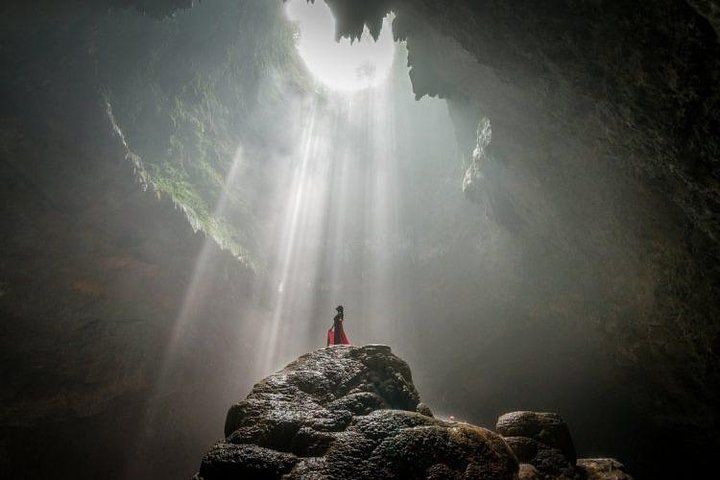
For the traveller who wants proven logistics: the most-reviewed option
Jomblang is a logistics puzzle, the long drive, the tiny daily cap, the rope crew, the timing of the light, and there is real comfort in booking with an operator who has run it hundreds of times. The 1 day Yogyakarta Tour Jomblang cave and Pindul Cave tubing is the most-reviewed cave option I know of, at 4.87 stars across eighty-six travellers. That depth of reviews matters more here than at a temple: it tells you the pickups, the descent slots, and the Jomblang-plus-Pindul sequence are a smooth, well-worn machine rather than an improvisation. When the day depends on hitting a capped morning window, proven beats novel.
The honest caveat is that the tour description itself is thin, it tells you less, on the page, about exactly what's included than I'd like. If you are a traveller who wants every inclusion spelled out before you commit, message the operator first and confirm the use, boots, and timing. The track record is strong; the write-up just leaves questions.
See dates & prices →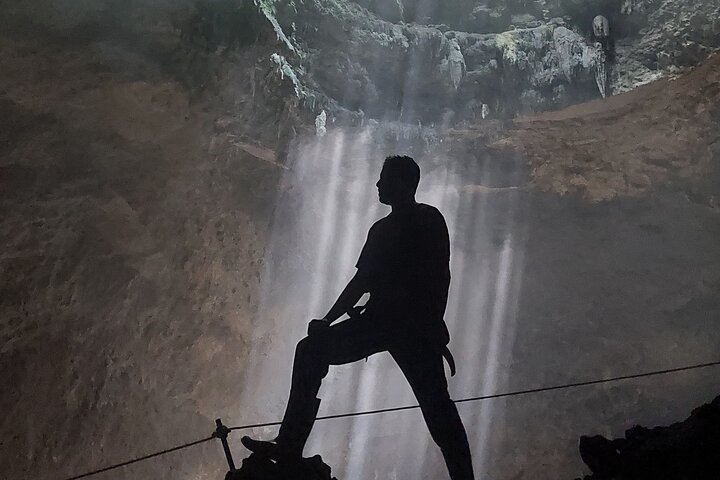
For the photographer who wants the sinkhole from above: the drone option
Some travellers come to the caves as much for the images as the experience, and the sinkhole from above is a genuinely extraordinary frame. The Yogyakarta Shared Tour: Jomblang & Pindul Cave with DRONE Option carries a perfect 5.0 across thirty travellers, runs at a shared-tour price, and adds something the others don't, optional drone footage looking down into the green collapse-doline and, on a clear morning, the Heaven's Light beam itself. If you want to leave with footage that actually shows the scale of where you stood, this is the day that delivers it without paying private rates.
The trade-off is built into the word "shared." A shared format means less control over the schedule, you move on the group's clock, not yours, and at a place where the light has a narrow window that group timing is set for you. If lingering on your own terms matters more than the drone, look at one of the others. But for the price, this is a lot of cave and a lot of footage.
See dates & prices →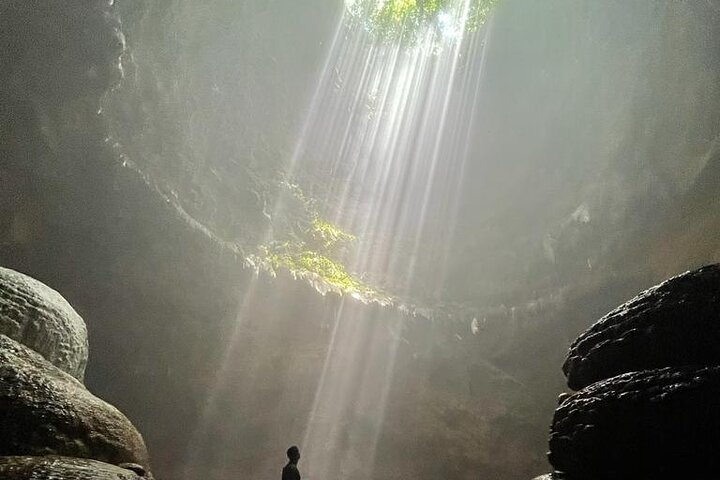
For the traveller who only wants the sinkhole: Jomblang on its own, with lunch
Not everyone wants two caves. Some people come for the rope and the light and nothing else, and stacking a second cave onto that just dilutes the thing they crossed the world for. The Yogyakarta: Jomblang Cave Guided Tour with Lunch & Pickup is Jomblang-focused only, at a perfect 5.0, with lunch and hotel pickup folded in. For the traveller whose whole reason for the trip is to descend into that sinkhole and wait for Heaven's Light, and who would rather give the morning fully to one cave than rush between two, this is the cleaner, calmer day.
Two honest flags. The review base is small, only nine, so there is less of a track record to lean on than the most-reviewed option above. And it skips Pindul entirely, which means you miss the gentle river that so many travellers tell me afterward was the part that actually moved them. If the contrast of both caves is what you want, this isn't it. If Jomblang alone is the dream, it's a focused way to live it.
See dates & prices →How I choose which cave tours to recommend
I apply the same three checks to every tour on this site, in the same order. Here is exactly what each one means in the caves of Gunungkidul:
1. Guide quality. In a cave this is not about reciting dates, it is about reading people. A good Jomblang guide watches your face at the lip of the sinkhole and knows whether you need a minute or a firm word before you go over the edge. A good Pindul guide knows where the bat colony is restless and where the dancing hall opens out, and tells the story of the stone without rushing the float. I trust operators whose guides treat the descent as a relationship, not a transaction, and who will quietly tell a nervous traveller it is fine to stop. The mountains taught me why this matters. Years ago, over on the Ijen crater in East Java, a sulfur miner I know turned back from his own load to drag a tourist out of a gas pocket the man had wandered into for a photo, the blue fire was beautiful and the wind had shifted and the tourist simply did not understand what the air would do to him. That miner read the danger the visitor couldn't see. That is the instinct I look for in a cave guide too: the one who is watching the conditions while you are watching the view.
2. Safety record. Of everything on this site, the caves are where this check carries the most weight. Jomblang is a sixty-metre vertical descent on a single rope with a belay, the use, the rigging, and the crew managing your drop are the entire difference between an adventure and an accident. I look for operators who provide proper equipment as part of the price, who respect the daily cap rather than overloading the rope window, and who treat the descent with the seriousness it deserves. At Pindul I look for life jackets issued without argument, including for strong swimmers, because an underground river in the dark is not a swimming pool.
3. Value. Not cheapest, value. In the caves this check splits in two, because the two caves sit at opposite ends of the price scale. At Jomblang, value means the price honestly includes the use, rope crew, and boots, and that a real morning slot inside the daily cap is secured, not a vague promise to "try." At Pindul, where tubing costs a fraction as much, value simply means you are not overpaying for something that is meant to be inexpensive. I earn a commission when you book through these Viator links, at no extra cost to you, that's how the site stays free. It does not change which tours pass the three checks, and plenty of well-paying listings never make it onto this page.
Rama's cave rules
- Book the Jomblang morning slot days ahead. The daily cap is tiny, only around twenty-five people in the prime late-morning window, and slots sell out. Turning up hoping to join does not work. This is the single decision that makes or breaks the day.
- Watch the weather forecast before you go. Heaven's Light is a sun-and-timing phenomenon, most reliable between ten and noon on a clear day. A cloudy morning, or an afternoon arrival, means you descended sixty metres to see a dim, ordinary cave. The forecast is part of your planning, not an afterthought.
- Carry cash, Gunungkidul is cash-only country. Cards do not work at Pindul or at most of the cave operations out there, and the nearest ATM can be an hour away. Bring more rupiah than you think you need before you leave the city.
- Pair Jomblang with Pindul for the contrast. The rope descent first, then the gentle tubing float, adrenaline, then calm. Most travellers tell me afterward that the contrast was the whole point. The two caves are close enough in the same limestone to do both in one day.
- Bring a full change of clothes for Pindul. You float an underground river in an inner tube, you come out wet, every time. Dry clothes and a towel waiting in the car turn the rest of the day from miserable to pleasant.
- Treat the descent seriously and listen to the crew. Jomblang is a managed vertical drop, not a queue. The use check, the belay, the order they send you over, that is the safety, not theatre. Do exactly what the rope crew tells you, when they tell you.
The mistakes I watch travellers make in the caves
The first and most painful is going to Jomblang without a reservation and without checking the weather. People treat it like a temple they can rock up to, not understanding that Heaven's Light is a sun-and-timing phenomenon and that the daily cap on the descent is tiny. I have watched travellers arrive cloudy at two in the afternoon, pay a great deal of money, descend sixty metres on the rope, and stand in a damp, dim Grubug chamber wondering where the beam was. There was no beam. There was never going to be one at that hour, under that sky. Book the morning slot, watch the forecast, and you give yourself the chance the light needs.
The second is assuming the daily cap is flexible. It is not. Only around twenty-five people make it into the prime window, and turning up hoping to be squeezed in simply does not work, the rope crew can only run so many descents in the hours the light is good. Every season someone tells me they'll "sort it out on the day." On the day, the slots are gone. The booking happened a week ago, online, for someone who planned ahead.
The third is assuming cards work in Gunungkidul. They do not, at Pindul or most of the cave country, and the nearest ATM can be a full hour's drive back. I have seen a family stranded at the Pindul ticket point, perfectly able to pay in theory, holding nothing but plastic. Bring cash, more than you think, before you leave the city ring road. It sounds small. Out there it is the difference between floating the river and standing on the bank.
Let me leave you with the morning I carry with me whenever someone asks whether Jomblang is "worth it." A grey day in 2019, an Australian family, and I had warned them in the car the way I am warning you now, that Heaven's Light might not show, that we'd booked the morning and watched the sky but the clouds were stubborn. We dropped the rope anyway and waited in the Grubug chamber in the half-dark. Just past eleven, the clouds tore open. The beam came down through the cave roof like something poured, a solid column of light standing on the chamber floor. Their youngest, maybe ten, whispered that it looked like the cave was breathing light. I have descended that rope hundreds of times and I still got chills. But I want you to hold both halves of that morning, not just the beautiful one, because the clouds nearly won, and on the cloudy afternoon it really is just a damp, ordinary cave. There is no winner among these tours, no single right cave for everyone. There is only the honest match between what you came to feel and the day that gives you the strongest chance of feeling it. Plan for the light. Then let the sky decide.
Explore More
Related comparisons and guides: